
Multipolarity Brief: Issue 3
Epstein and Punishment; Warsh Zone; Nuclear START Stops; Mount Sanae; Erdogan Gets the Horn?; Meiji Restoration; Russia's Cyborg Spy Pigeons and more...

These days, geopolitical events are moving so quickly that Lenin’s quote, “There are decades where nothing happens; and there are weeks where decades happen,” is becoming an overused cliché. Trying to keep up with this pace of change is exhausting. Multipolarity Brief will help you maintain your bearings by offering a weekly digest of the key geostrategic events — but as they are, not what the official narrative claims. In the words of that great 1980s American philosopher, Ferris Bueller, “Life moves pretty fast. If you don't stop and look around once in a while, you could miss it." Hit subscribe, and once a week stop for a look around the geopolitical landscape with us.
Epstein and Punishment

This week, the Epstein files claimed their first big name political victims — but not in America, ironically enough. Peter (née Lord) Mandelson, one of the most powerful fixers and kingmakers in British politics for the last three decades, was forced to resign from the Labour Party and the House of Lords after the latest tranche of Epstein Files was made public. His connection to the notorious sex offender had already led to him being sacked as Britain’s Ambassador to the United States in September last year. More damagingly for the present British government, Prime Minister Keir Starmer’s influential chief of staff, Morgan McSweeney, was also forced out as a result of his ties to Mr Mandelson.
Multipolarity View: It seems to be beyond the ability of the British press to fast forward the tape and see how dangerous this could be. In recent years, the UK sovereign debt market has appeared increasingly vulnerable, most notably during Elizabeth Truss’s short and ignoble premiership. Keir Starmer now looks like a dead PM walking, much as Boris Johnson was after Cakegate, the scandal centred on then-illegal parties he had attended in Downing Street during lockdown. Indeed, like Mr Johnson, Mr Starmer has never been particularly popular with his MPs. Instead, both men were tolerated while they looked like winners. Now, there are already calls for Mr Starmer to go, including from the leader of the Scottish Labour Party.
If Labour does as badly in May’s local elections as opinion polls suggest they will, the clamour for Mr Starmer to leave would no doubt intensify. It is entirely possible, therefore, that Britain has a new prime minister by the end of the summer. Long before that, bond markets would surely price in the chance that the left of the party wins the battle. That would mean higher spending, and commensurately greater bond issuance. What happened the last time bond markets thought that Britain would run a much bigger deficit? Ask Liz Truss. Could Jeffrey Epstein bring down the British economy? Maybe.
Warsh Zone

In an interview with Fox Business, US President Donald Trump said that his nomination for Chairman of the Federal Reserve, Kevin Warsh, would be able to conjure economic growth of 15%. Back on planet earth, investors and analysts are understandably keen to get a fix on what sort of Fed Chairman Trump’s man will be. Over the years, Mr Warsh has offered numerous opinions on the central bank’s monetary and regulatory policies, but none has garnered more interest in recent days than his support for “a new accord” between the Federal Reserve and the US Department of the Treasury.
The present accord dates back to 1951. During and immediately after the Second World War, the US Federal Reserve had capped US sovereign bond yields to hold down the cost of the tremendous government borrowing needed to fund the war effort. The 1951 accord, during the presidency of Harry S Truman, removed the shackles on Fed monetary policy, allowing the central bank has set interest rates independently, which it has done since.
Hold that thought, because the US Federal government is currently running a deficit of almost 6% and spending nearly a trillion dollars a year just to service its grotesque sovereign debt pile. Given the president has said that the Fed should “mind” national borrowing costs when setting interest rates, it does not take an Austrian economist with a paranoid disposition to worry that we may be about to see some sort of yield curve control — a policy by which specific points of the US Treasury yield curve (i.e. specific maturities of US Treasury bonds; for example, the ten-year or the two-year) are targeted by the Fed with a view to keeping their yields lower than the market would set on its own.
Multipolarity view: So financial repression is finally on the table. It was always going to be a tempting option after the mountains of debt taken on in response to the 2008 financial crisis and Great Recession. Indeed, famously, the economists Carmen M. Reinhart and M. Belen Sbrancia wrote a paper in 2011 titled The Liquidation of Government Debt which argued that governments might return to financial repression to deal with debt following the 2008 economic crisis. If it was true after 2008, it must have been doubly true after the Covid lockdowns battered national balance sheets with another tsunami of debt.
So what would it mean for the US economy? Classically, financial repression is good for those in debt, because inflation rises faster than interest, reducing the real value of debt over time. That means heavily indebted Americans and the government would be beneficiaries (“Inflating the debt away”!) It would also be positive for the stock market, because the discount rates used in equities valuations would decline. Real assets, like commodities (gold, oil, pork bellies), real estate, infrastructure and similar, would also enjoy a boost. In fact, the markets in general are likely to boom as investors would see the introduction of financial repression as a continuation of the limitless Fed liquidity paradigm of the last 15 years or so.
If the winners would be the government, those in debt and the holders of assets, who would be the losers? Pensioners and those with savings (who would see the value of their savings erode over time), large holders of debt (which banks have lots of mortgage debt on their books?) the US dollar (which would decline as a store of value) and ultimately the economy itself as worsening capital allocation and credit distortions have their effect.
Nuclear START Stops

On 5 February, the Strategic Arms Reduction Treaty (START), the last bi-lateral nuclear arms control treaty between the US and Russia, expired. START was signed in 2010 by then presidents Barack Obama and Dmitry Medvedev. It capped each side’s deployable strategic nuclear warheads at 1,550, with limits on delivery systems, such as missiles, submarines and bombers. Russia made an offer to extend the treaty for a year, but this has not been accepted, although both sides have agreed to restart high-level military discussions. For the first time in decades, there are now no nuclear arms limitation treaties between the two preeminent nuclear powers.
Multipolarity View: What have the Oreshnik, an intermediate rage missile that delivers multiple, hypersonic warheads against which there is no known defence, the Poseidon, a long-range, 100-megaton nuclear torpedo designed to cause radioactive tsunamis, and the Burevestnik, a cruise missile whose nuclear engine gives it effectively limitless range, got in common?
They were all designed to defeat any anti ballistic missile defence system the US might develop.
The unravelling of the hard-won Cold War arms limitation treaties really started with the neoconservatives, in 2002. The George W Bush administration unilaterally withdrew from the 1972 Anti-Ballistic Missile Treaty, arguing that it needed to develop an anti-ballistic missile system to combat ‘rogue states’. Strangely, the decision to base this system in Eastern Europe’s newly minted NATO member states made the Kremlin rather nervous. B2 Stealth bombers and Ohio Class could deliver weapons with little or no warning; the weapons they delivered were accurate enough to be considered first-strike weapons. Could whatever was left of Russia’s arsenal after a first strike be mopped up by ABM systems in Romania and Poland? The Kremlin decided it was time to develop second strike systems that would be guaranteed to penetrate — a development programme that has now reached fruition with Oreshnik, Poseidon and Burevesknik, all of which make the world a more dangerous and frightening place.
Given China is rapidly building out its own nuclear weapons arsenal — seeking to reach parity with the US both in volume and variety — and Moscow has been forced into partnership with Beijing, the US faces a tripolar nuclear order in which Washington is the odd one out. In this world, Beijing would enjoy escalation dominance. Like every other neocon policy, the slow exfiltration from all the cold war arms limitations treaties will prove to be a strategic blunder. MAGA would do well to revisit its decision.
Mount Sanae

Prime Minister of Japan Sanae Takaichi’s gamble on a snap election paid off spectacularly, as she won by a landslide and thus secured a resounding mandate for her policies.
A brief explainer. Ms Takaichi had called an election for the House of Representatives, the lower house of the Diet, Japan’s legislature. As in Westminster, the lower house is the more powerful: it controls the budget, selects the prime minister, and can override the upper house in certain circumstances. Ms Takaichi’s Liberal Democratic Party (LDP) won some 316 of 465 seats, giving it an absolute majority. With coalition partners, the LDP now controls a two thirds supermajority that would allow it to ram through legislation over any opposition or upper house objections.
Multipolarity View: Some sections of the western media hailed Ms Takaichi’s landslide victory as a breakthrough for the position of women in Japanese society. A typically vacuous view. Japan has not overnight become any less conservative, let alone embraced the sort of right-on women’s lib preferred by Anglo-Saxon metropolitan progressives. Sanae Takaichi won despite the fact she was a woman, not because of it. Her victory demonstrated the popularity of her policy platform — lowering the consumption tax on food to ease the cost of living crisis, large scale fiscal stimulus to boost growth, a pledge to raise defence spending, and more of a conservative slant to social policy.
The decisive win propelled Japan’s stock market to record highs as equity investors responded positively to the end of policy uncertainty and the promise of a wave of fiscal stimulus. Not such good news for Japan’s sovereign bond yields, which also rose, and for the same reason: more budget deficits mean larger debt issuance. Readers might expect further bouts of worrying yield movements in the JGB market. The election result was also a win for Washington: Ms Takaichi intends to increase defence spending to 2% of GDP and has taken a more assertive line with China.
Erdogan Gets the Horn?

This week, the government of Somalia signed a Memorandum of Understanding with Saudi Arabia to help strengthen the former’s security situation as tensions rise over the breakaway Somaliland region. Turkey earlier sent F16 fighter jets to help support the army of Somalia. Both moves were likely a response to Israel’s decision on 26 December last year to formally recognise the breakaway nation of Somaliland. Israel became the first nation to do so.
Multipolarity view: For that, dear readers, you will have to become dear listeners. On Thursday, the Multipolarity Podcast will speak to Firas Modad, the founder and principal of Modad Geopolitics, which provides commercially relevant analysis of the effect of geopolitical change on specific regions and industry sectors. Firas is a mainstay geopolitical commentator on the podcast circuit and hosts his own podcast, Realpolitik, within the burgeoning Lotus Eaters ecosystem. Our last interview with him was one of the best received Multipolarity episodes ever. Want to know what’s really going on in the Horn of Africa? Whether the US will attack Iran? Listen on Thursday.
Multipolarity Elsewhere
Multipolarity co-host Andy Collingwood penned a feature for the Spectator on Venezuela, Greenland and US national security strategy. It can be read here.
Geopolitics On This Day…

…in 1889, Japan formally adopted the Meiji Constitution, which gave the country a political system that was part constitutional monarchy and part absolute monarchy, influenced by Britain and Germany. The constitution was part of the broader Meiji Restoration, which replaced the Tokugawa Shogunate with imperial rule, and attempted to Westernise Japan after decades of backwardness and forced opening to trade under unequal treaties with the west. It was a process that eventually led to Japan’s ascent to great power status in the early 20th Century and the creation of an empire of its own.
You’ve got to cry a little…
US tax dollars hard at work. Weren’t these guys defunded?

…laugh a little…
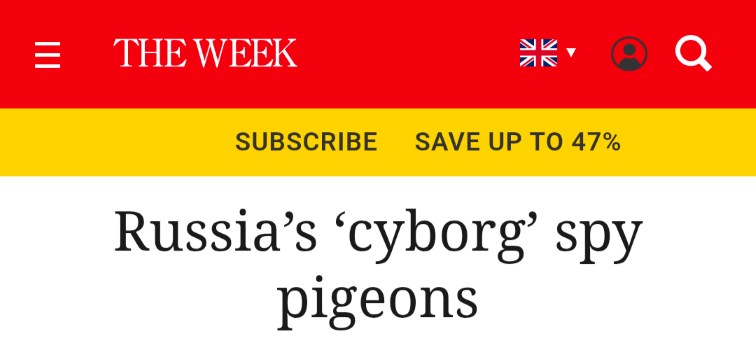
Headline of the week. Believe it or not, it’s not ironic, or an Onion style joke.
…before the clouds roll in a little
Come on, if you got this far, you know that this was pretty good and took a lot of time to produce. In return, do you think you could take ten seconds to share and recommend Multipolarity Brief with anybody you think might enjoy it (or need it!) Realistically, though, you know and I know that this was worth one pound/dollar/euro and fifteen pence, cents or cents, wasn’t it? It comes to you every week for free, but you can show your appreciation by subscribing here or Patreon for only five quid, bucks or euros a month. If you do, you’ll also get all our premium podcast episodes, and the back catalogue (in which there are some absolute gems). That’s a ridiculously good deal. Are you honestly saying that a buck fifteen a week is beyond your budget? Really?
Multipolarity Brief will return next Tuesday
Until then, farewell and good luck.