
Multipolarity Brief: Issue 6 — Iran War Special
Why did it start?; The illusion of regime change by air; Iran and countervalue vs counterforce; A race of munitions and a battle of pain tolerance; Regime change or national dissolution?

A break in normal programming. This week, we cover one issue and one issue alone. There are so many bad takes, so much nonsense being written and spoken — often by people who should know better and others who appear to have no capacity for logic whatsoever — that Multipolarity has decided to devote this entire Brief to offering a strategic explanation of events so far. This Brief will thus provide readers with the correct framework for viewing the conflict and judging its outcomes. It will put you weeks ahead of most other people.
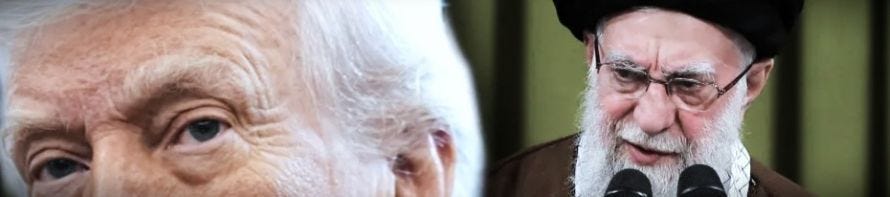
On 30 January, Andy Collingwood, Multipolarity co-host, wrote on X (formerly Twitter) that should “accept reality: a US attack on Iran is coming.” The argument he laid out in the post was as follows. The Twelve-Day War and the general diplomatic posture of Israel and the United States would have persuaded Iran that it needed nuclear weapons as the ultimate guarantor of regime and national survival. Nuclear weapons, however, would be impossible to obtain without a means of protecting the programme until deliverable warheads became operational. Otherwise, as soon as Israel and the US observed such a programme, they would destroy it. Protecting the country from such an attack would require a modern air defence suite — including surface-to-air missile batteries, a modern air force, and a means of integrating it all — in addition to rebuilding its own missile strike capacity, which had extracted a high toll from Israel during the aforementioned Twelve-Day War. There were signs that Iran was starting to follow exactly this route, with Tehran reportedly exploring deals with China and potentially Russia for modern fighter jets and air defence systems.
Collingwood argued that the US and Israel would not wait and allow Iran to make itself a much more difficult target, and eventually a near impossible target; doing so would be to acquiesce ex ante to a nuclear Iran. He argued that the US military build up — then only a week or two old — was evidence that Washington was thinking on these lines. On 2 March, Marco Rubio, the US Secretary of State confirmed Multipolarity’s pre-war thinking was almost exactly correct. He told the press that the US had gone to war with Iran at least in part because it was trying to “put themselves in a place of immunity where…no one can do anything about their nuclear program or their nuclear ambitions.”
There is another line of thinking about US war motivation. This argues that the US go-decision was part of its great power competition with China. First, Beijing sources as much as 50% of its crude oil and 30% of its LNG needs from Gulf countries. Any disruption would surely hurt China more than the US, which is an energy exporter. Secondly, victory and the installation of a puppet regime in Tehran would mean the US was allied with every single energy producing Gulf country, and would therefore have its foot on China’s energy jugular, something Washington could forever use as leverage to extract concessions from Beijing.

This line of argument does not bear consideration. Since the end of the Second World War, Washington has been clear that it cannot tolerate anything other than a US-friendly regime in Tehran. To that end, it conducted Operation Ajax in 1953 to overthrow Mohammad Mossadegh, who had threatened to nationalise the Iranian oil industry. In his stead, Washington installed Shah Mohammad Reza Pahlavi, a hugely corrupt, autocratic and oppressive ruler who nevertheless modernised and secularised the Iranian. When he was overthrown in 1979, the US backed and helped arm Iraq tyrant Saddam Hussein to attack a temporarily weakened Iran. It continued backing him even after Hussein had used weapons of mass destruction on the battlefield.
Washington has since tried on several occasions to overthrow Iran’s theocratic regime, most notably in 2009, then through maximalist sanctions from 2015, and finally in January of this year. Furthermore, Israel has also made it clear that it sees a narrowing window of opportunity to collapse the present regime in Iran. First, it has weakened Hamas and Hezbollah, which means the Israeli home front is less vulnerable. Secondly, Jerusalem apparently believes Iran itself was militarily depleted by the Twelve Day War and internally weakened by the early 2026 protests — both temporarily.
Thirdly, after the midterms, Donald Trump could lose control of Congress and become a lame duck president. After that, it is possible that the next president could be from the more Israel-sceptical Democrat Party. Donald Trump, on the other hand, has always been extremely pro-Israel. For Jerusalem, therefore, it could be now or never. Given the power of the Israel lobby in US politics in general and especially in the court of Donald Trump, this is likely to have been an important push factor in US decision making.
The idea, therefore, that this time it’s about China seems risible, given the historical and political context. The US wants a pro-Washington leader in Iran, as it has since 1945. Israel sees a window of opportunity. Any leverage gained over China from attacking would only be a bonus.
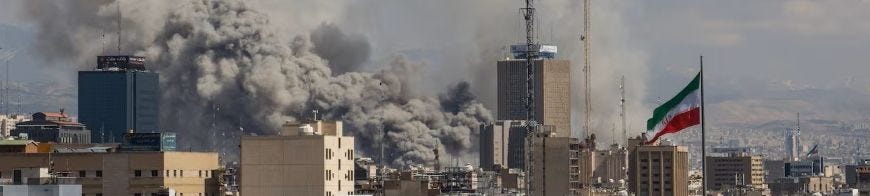
To this end, the US and Israel have engaged in several days of high intensity air attacks with the stated goal of regime change. The problem is that this has never worked before. Professor Robert Pape, who literally wrote the book on the use of air power for the purposes of political coercion, contends that not once in history has airpower alone achieved these aims. Instead, the bombing itself is likely to lead to radicalisation and a rally-around-the-flag effect, strengthening the regime’s hand at home.
Furthermore, Professor Pape argues that while the decapitation strikes and attacks on command and control infrastructure are likely to be a tactical success, that success itself causes a “phase shift” in the war after which the attacker is compelled to get yet farther involved. “The state does not disappear. It fragments. And fragmentation multiplies risk. Shipping lanes face harassment from semi-autonomous actors. Energy infrastructure becomes vulnerable to deniable attacks. Cyber operations disperse across networks no longer tightly managed. Nuclear material security becomes harder, not easier, to guarantee.”
The main illusion of policymakers, contends Professor Pape, is that escalation is reversible. In reality, once they have smashed central control of Iran, its reestablishment is no longer a unilateral decision. In this scenario, “Trade-offs multiply across domains: alliance commitments, other regional priorities, great-power competition, fiscal constraints. Corporate America faces parallel trade-offs: chronic supply risk, repriced insurance, prolonged volatility in energy and shipping. And these trade-offs do not recede because a president decides to move on.”
Have events so far born out Professor Pape’s views? Yes. The decapitation strikes and attacks on Iran’s strategic infrastructure have indeed been successful. For instance, Iran is churning through defence minister after defence minister as they are killed almost as quickly as they can be appointed. Meanwhile, decision making to individual commanders in the field as part of Iran’s ‘mosaic defence’. Yet regime change has not been obtained. Whether the US can now withdraw before the ‘phase shift’ happens and Washington is sucked in for good is another matter. If it does not withdraw, Professor Pape contends that, strategically, the US will have converted “episodic volatility into chronic instability” and find itself “structurally entangled.” Yet withdrawal is not a unilateral decision, either: a withdrawal while Iran is still attacking US regional allies would look indistinguishable from strategic defeat.
Iran’s responses to the US attacks are not an example of “flailing”. Nor are they ‘foolishly attacking neighbours and turning the whole region against them’, as some from the dimwit wing of geopolitical analysis have argued. In fact, Iran has been pursuing a counter-value rather than a counter-force strategy. Rather than taking on the US military (against which it surely knows it would lose as a vastly inferior force), it is attempting to use pain to make Washington stop.
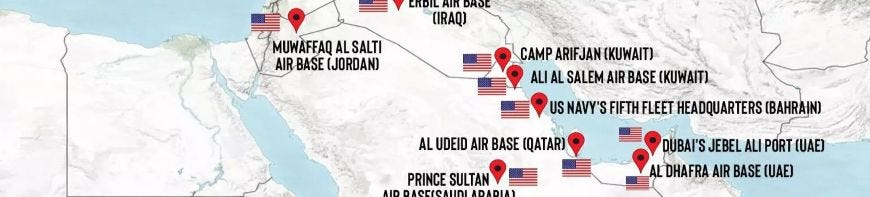
It has attacked US military bases across the region, including in Bahrain, Saudi Arabia, Qatar, Kuwait and the UAE. Symbolically, the Headquarters of the US Fifth Fleet, in Bahrain, has taken a pasting. It has also hit some hotels, which appears to have been connected with the fact the US evacuated said bases before hostilities started, and housed the service personnel from the bases in said hotels. It seems some servicemen have sadly perished in this way.
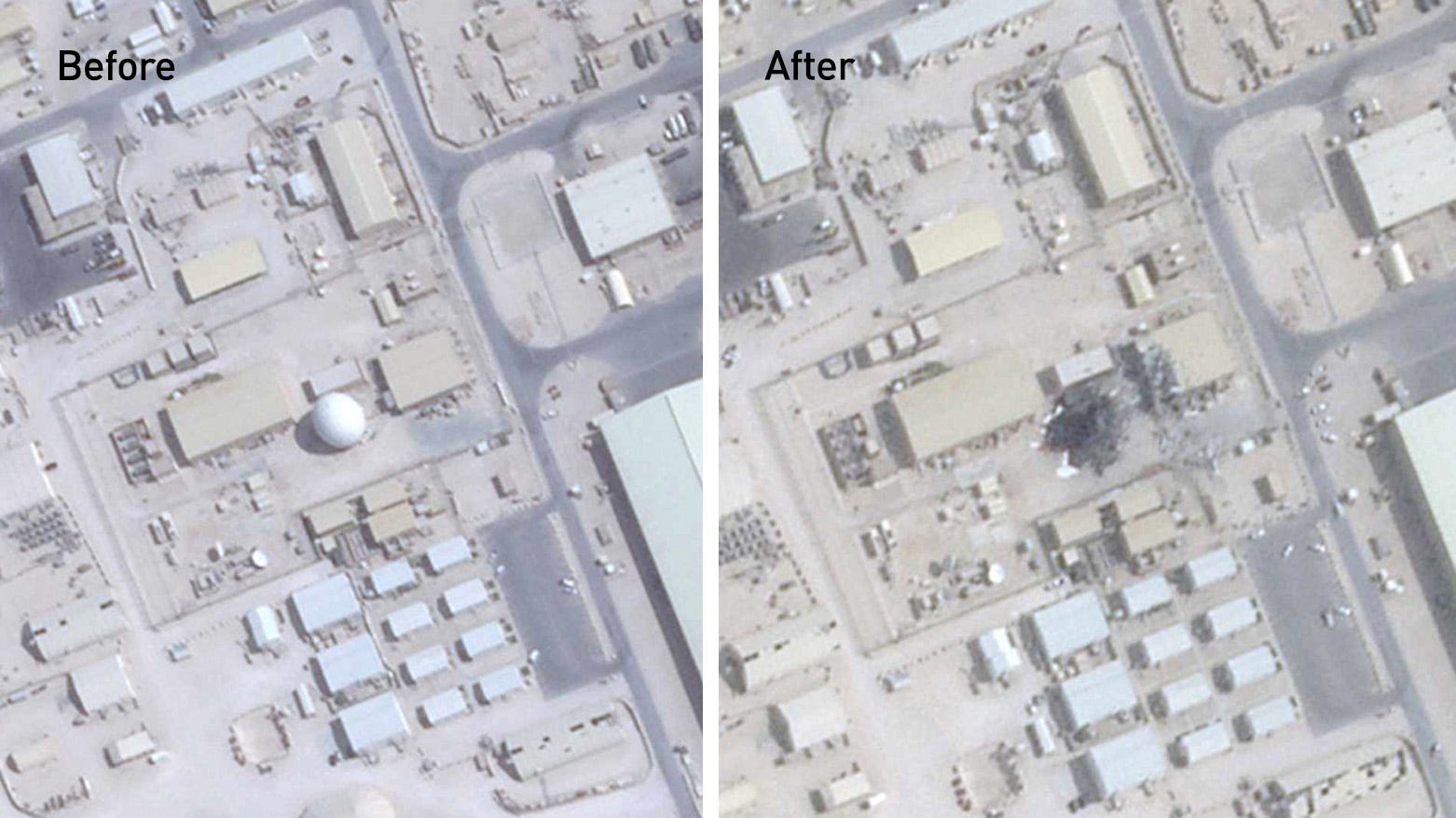
Crucially, though, Iran has also destroyed several radar installations, including at least two large, permanent, early warning radars costing several hundred million dollars each; even more importantly, Iran has hit two radars attached to THAAD anti-air missile systems. Every anti-air battery that is incapacitated, and every interceptor the US uses to take out $10,000 drones, marginally increases the value of the remaining Iranian arsenal.
If the US runs out of interceptors entirely, it effectively suffers a strategic loss: Iran, while still being pummelled itself, would be able to dole out an almost equal punishment to Israel and other US allies within the region. This would bring the war to the logic of the strategic nuclear exchange: a battle of pain tolerance as cities are exchanged. It would seem that Iran would have a greater pain tolerance than, if not the US, whose cities would not be destroyed, then certainly its Gulf Monarchy allies, who might be willing to cut a deal with Tehran in such circumstances. In this scenario, the darkest possible outcome would be Israel forcing a halt to affairs through nuclear postering — up to and including first use against Iran.
It is important to note here that, after sending many interceptors to Ukraine, and using a large number in the Twelve Day War, the US magazine is not as full as it would like in such circumstances. The Gulf Monarchies are already complaining that they are approaching the end of their stocks, and that the US has ‘abandoned’ them in favour of Israel. They are reportedly now lobbying other allies in the west to help them persuade the US to help. Indeed, leaks are even emerging from the Pentagon (at an extraordinarily early moment of the play) that the US itself is running short of air defence interceptors, a fact Donald Trump is blaming on the foolishness of his predecessor, Joe Biden, for giving them to Ukraine.
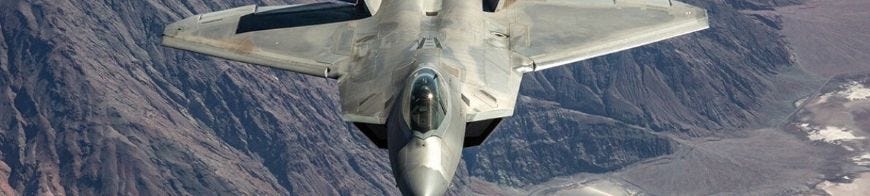
Ultimately, though, if the US does not run out of interceptors fairly quickly, Iran will have to climb the escalation ladder if it is to inflict enough pain for the US to stop. Eventually, the USAF will degrade Iran’s air defences enough to put combat air patrols deep into Iranian territory. At that stage, the US would be able to mount its almost limitless supply of JDAM bombs (dumb bombs with a GPS-guidance kit attached) on fighter bombers roaming over Iran. Shortages of Tomahawks and JASSMs would cease to be an issue. Bringing out missile launchers would be hugely risky for Iran in such circumstances.
Therefore, it is in Iran’s interest to escalate before it reaches this point; to attempt to inflict enough pain on the United States that it seeks terms of a ceasefire. (The same would be true if the Iranian government felt it was close to overthrow, although that does not seem an issue now, with command increasingly devolved to local commanders as part of its ‘mosaic’ defence.) It is for this reason that closure of the Strait of Hormuz — which seems to be the limit of the imagination of the Western media — is not the worst case scenario. The realistic worst case scenario is that Iran seeks to systematically destroy all oil and gas infrastructure near the Gulf, meaning that only a fraction of average energy volumes could travel through the Strait of Hormuz irrespective of whether it was ‘open’.
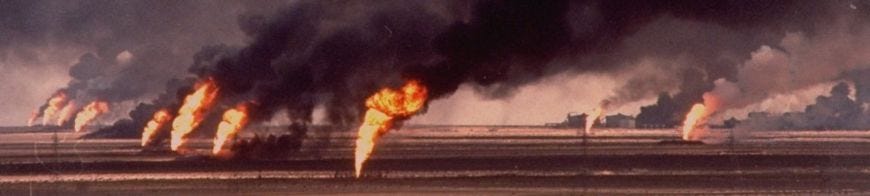
Recall that when Iraq retreated from Kuwait in 1991, it set the kingdom’s oil wells alight. It took almost a year to extinguish the fires and cap the wells. A Gulf region with vastly reduced oil exports for eight or nine months would likely produce a global depression. Tehran would want to credibly demonstrate that it could take such action, while holding the act itself in reserve — the promise of intolerable pain. Here, Philip Pilkington, the Multipolarity co-host, argues that Dubai has been a particular target because it is the Gulf financial centre, and heavily tied in with the City of London and other global financial centres. Thus, any economic or financial crisis there would more efficiently reverberate through the West.
(As an aside: serious analysts and ‘experts’ have been repeating that Iran “cannot” physically close the Strait, especially now that its navy has been destroyed. This is preposterous. In fact, it is trivially simple for Iran to close the Strait: all it has to do is make ships uninsurable for passage. Shame on all those ‘experts’ who saw the Houthis keep the entire Red Sea effectively closed, yet claim Iran cannot shut the Strait. Unserious, and disqualifying for further trust.)

The Gulf monarchies, of course, have their own military forces. Saudi Arabia’s are significant, even if they pale in comparison to Israel’s and certainly the US’s. So why aren’t they firing back at Iran? Why are they just taking the blows? First, there is very little they could add to the US-Israeli effort already underway. The sky is already saturated. The USAF would probably run out of targets before it would need help from the Kuwaiti Air Force. A nine-year old girl is not a help to Mike Tyson in a fist fight; indeed, she might be a hindrance.
Secondly, as we have written, Iran has a great deal of room to escalate. Much as a shutdown of Gulf energy production would be a disaster for China, India, Europe and the rest of the global economy, it would be a catastrophe for the Gulf monarchies. They may not survive. At the least, they would face economic crisis, and the market for their oil and gas would permanently shrink as demand destruction and a scramble for renewables took hold. It is true that Iran has its own oil and gas industry to lose in such an exchange, but if Iran is on the way out anyway, it would seem to have rather less to lose than the UAE or Qatar.
The main problem the United States faces is not only that it finds itself in a munitions race with Iran whereby the USAF attempts to destroy Iran’s ability to inflict significant pain on US allies in the region before the US runs out of interceptors. The problem is in fact more fundamental than that. What, exactly, is the US theory of victory? The aforementioned Robert Pape argued that regime change cannot be obtained by air power alone, and so far, he has proven correct. Indeed, so many of the Iranian elites have been assassinated or killed by air attack that it is difficult to know who the US would negotiate with, or who would form a new regime.
But what if that was the point? What if the point was not Regime Change but National Dissolution — i.e. to make Iran ungovernable or otherwise unviable as a state? In 1982, Oded Yinon, the Israeli analyst and journalist, argued that Israel’s security interests would be best served by stirring up ethnic, religious and sectarian divisions within the Arab States. This could be used to set off internal conflicts that might even lead to civil conflicts that would occupy and weaken the Arab states. Ultimately, they could balkanised into smaller statelets that would be far weaker and could be held in a state of tension against each other.
Lebanon has already been reduced to chaos and penury (at least in part by its own hand, it must be said), and the dynamic between the government and Hezbollah is a particular source of tension at present. Syria has certainly been ruined by civil war, and Israel now occupies a large part of the south of the country, almost up to Damascus, in cooperation with the Druze. Turkey essentially occupies parts of the north. Mr Yinon specifically advocated for a semi-autonomous region of Iraq for the Kurds, centred on Mosul, and this now exists in reality.
Could the same thing happen to Iran? It would be far more difficult than Syria. Iran has much stronger institutions and a far greater history as a state. Nevertheless, the evisceration of the country’s political, military, intelligence, and clerical leadership, the destruction for of their physical infrastructure, and the recent talk that the Kurds will be armed and encouraged to intervene — which would surely draw Turkey into the fight — suggests that it is possible at least that the aim of the US and Israel might be (perhaps as a fall back option if regime change cannot be obtained) national dissolution.
Of course, this is exactly the ‘Phase Shift’ Professor Pape discussed, during which “fragmentation multiplies risk” and entanglement becomes structural.
But for more outcomes, readers will have to return in coming days. What would happen if the Kurds entered the battle? How will this affect the US global position? Which nations and powers will be the main losers of the war? What does this tell us about the US ability to defend Taiwan? Subscribe, for free, to be informed as soon as the answers arrive.
Important acknowledgements
The author would like to thank certain people who, if this had been an academic paper, would have been properly credited with multiple footnotes.
First, Anusar Farooqui, known online as Policy Tensor. The writing above on Iran’s countervalue strategy and the strategic battle of pain tolerance are his ideas or drawn from his analysis. He deserves any credit — and my apologies if I have mangled his arguments in any way. Please follow him on X (formerly twitter) @policytensor, and subscribe to his brilliant Substack, Policy Tensor. You will be richer for doing so.
Secondly, thanks to Amerikanets, whose analysis of this war has been first rate. The above writing on the hotel attacks and the theory of remaining Iranian missile value was based on his ideas. There might be other ideas of his intertwined with mine, because the author reads all his X posts. Do follow him on X (formerly twitter) @ripplebrain, and subscribe to his Substack, Amerikanets.
Until the Clouds Roll in a Little…
Did you think the effort we put into this brought you some value? Then take 10 seconds to subscribe, for free, right now. Take another ten to send this to somebody who would benefit from reading it. And if you’re one for a killer deal, for only eight bucks you can subscribe to Multipolarity the Podcast on Patreon. In return, you’d get all our premium podcast episodes, including the back catalogue (in which there are some absolute gems). Blinding deal.
Multipolarity Brief will return with a normal issue next Tuesday. Until then, farewell and good luck.
Great write up.
* Spot on about Gulfies being in no position to escalate, and being most vulnerable. Not to mention let down by US, as CENTCOM forces disperse from bases to hotels and beyond. And to nobody's surprise, air defense supply prioritized to Israel and own ships at sea.
* Turkey positioned to benefit by sitting it out while all rivals smash each other. But liable to come in late in the game if opportunity presents, and it probably will somewhere (maybe Lebanon/Syria who knows). Erdogan won't be able to resist and he thrives in conflicted situations such as this. Not in a hurry to help end the crisis.
* Kurds are IMHO a cover to host mercenaries on behalf of US/Israel. I don't believe anything from there is organic. Pronouncements notably ambivalent so far. Cooperation of Turkey required too to make it work for US/Israeli goals (due to geography), and this guarantees Kurds getting screwed in the end.
* China perfectly fine, in an oil/gas shortage they're now in the ranks of wealthy nations who can bid high for whatever there is. Also not in a hurry to see it stop
* Russia, definitely not in a hurry to see it stop
* US 95% impervious in reality. Casualties will be hidden. Weak points is Trump's personal power at stake if global economic shock gives Dems both houses of Congress. They'd impeach him for financial improprieties (and skip the Epstein stuff, since they're compromised too), and possibly convict if Netanyahu not around to save his hide. Unfortunately there's no pathway for this incentive to lead to anything, Vietnam-war type logic on autopilot now.
* Israeli national infrastructure actually quite vulnerable, if Iran has a good system of deploying its IRBM's from underground. Unclear as of now, too much propaganda.
* Iran is committed, rather obviously. Likely to suffer terrible casualties as a frustrated US does what it has since the 50's and tries "strategic bombing".
* Iraq and Yemen wildcards.
I think that's everyone of consequence.
Great piece! thanks for your work - your twitter account brings so much value in times like these. This summary answered a lot of questions but opened a new one: you write that Iran will "attempt to inflict enough pain on the United States that it seeks terms of a ceasefire."
What kind of a deal/ceasefire could the US possibly offer Iran that would make it stop attacking israel and us bases? Iran is in a fight for survival and the US did not honor the previous deal and pretended to negotiate two times just to start a surprise attack. How can Iran trust that the US or Israel would honor any agreement?