
Multipolarity Brief: Issue 18 — Iran Special XII
Oil I want for Christmas is Crude; Rubble Double, Toll and Trouble; Bibi’s buzzkill

One week on, and the Iran War story hasn’t changed – but it is being shouted ever more loudly. Soon, it’ll be screaming because we are now rapidly approaching crunch time. It is therefore a good moment to have a serious look at the state of play. It can seem confusing, because the signals are so contradictory. US President Donald Trump says a deal is close, yet his stated position on the post-bellum arrangements for the Strait of Hormuz are diametrically opposed to the Iranian position. This would seem like a big barrier to the conclusion of a peace agreement, no?
Meanwhile, Marco Rubio says an agreement is just days away, but the Iranians and US are now exchanging fire again, albeit sporadic. Then we have Tehran saying that any deal must cover Israel and Lebanon, and yet Israel is hitting Lebanon harder then ever. Over the holiday weekend, the US leaked a potential deal that looked a country mile short of meeting Tehran’s demands. And yet even that outraged the neocon warhawks in Washington.
Most recently, President Trump has demanded, via Truth Social, as is his wont, that all Middle Eastern countries join the Abraham Accords as part of any deal. And finally, Iran has set up an authority to manage the Strait of Hormuz, and Scott Bessant, the US Treasury Secretary, has immediately sanctioned it, and is threatening to sanction any nation that even deals with it.
What on earth is happening? How can a deal be as close as the press and insiders seem to think? Can we try to work out a theory that makes sense of what’s going on?
Oil I want for Christmas is Crude

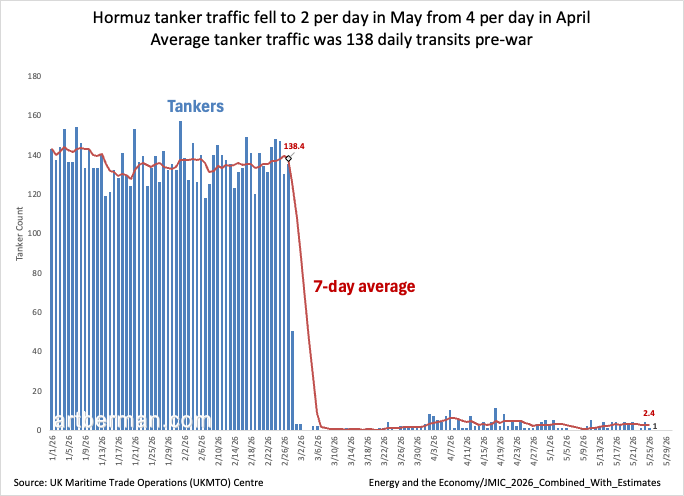
Let us begin by surveying the backdrop to negotiations. The most important part of the terrain is that the Strait of Hormuz remains effectively closed. Hardly any oil is getting out. There is always somebody on X (formerly Twitter) who claims that the Strait is opening because one or two Very Large Crude Carrier tankers have creeped through the twin blockades. Give such people short shrift. They are almost always grifters or political partisans. They usually announce it like a great victory. But look at the chart below. It should dispel any such foolishness.
Source: Art Berman, energy consultant and keynote speaker. See: www.artberman.com
In fact, looking at that chart, we see May’s figures are lower even than April’s. The oil squeeze is only getting tighter. A few tankers squeezing through isn’t a signal: it’s noise. And barely audible noise at that! So, what does this chart signal? It signals ‘catastrophic supply crisis’. It signals ‘massive worldwide energy crunch’. It thus signals ‘global depression’.
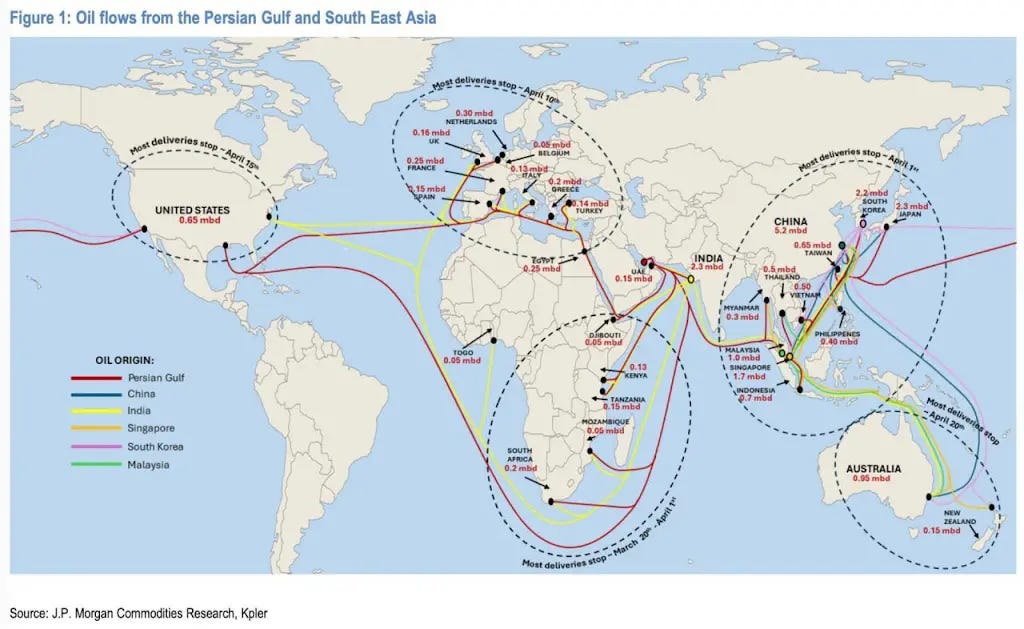
Yes, yes, we’ve been writing about this doomsday scenario for weeks, and it hasn’t yet happened. It is worth looking at why. There are three reasons. First, of course, is that the ships take time to get from the Gulf to their ports. So he last ships leaving the Gulf in March took into April to reach Europe and even later to reach the US (map, below). Then, countries used commercial reserves.
Secondly, China has managed to respond by significantly cutting its imports. As we were one of the first to comprehensively explain, China was simply not as vulnerable to being cut off from Gulf oil as widely assumed. It only accounted for some 6% of its total energy use. The country’s energy mix gave it ample room for optimisation. Tts existing deployment of technology would allow it to reduce its reliance on oil. Tt was a net exporter of refined products. And it had massive crude oil reserves. China could significantly reduce its imports from the Gulf (and even overall) without suffering too much pain in the short and medium term, we argued.
What happened? Exactly that. From the Wall Street Journal:
“Chinese crude imports in May are now tracking around 6.6 million barrels a day, the lowest level since 2016, Kpler data showed. Weaker refining activity and lower exports of refined products are weighing on domestic operations, sharply reducing Beijing’s crude purchases from Russia, Africa and parts of the Americas, according to the data provider.”
This reduction is, to a large extent, saving the rest of Asia from a significant economic downturn. It is unlikely to last forever. The above quoted WSJ article contends that the ability to reduce imports is based on refiners in China preferring to draw on inventories (reserves) than pay the inflated prices for imported crude. This cannot continue indefinitely, but it is helping to balance markets. For now.
The third factor papering over energy market cracks in recent weeks has been heroic drawdowns from the US Strategic Petroleum Reserve. Bloomberg’s Chief energy columnist Javier Blas reported another “mammoth” drawdown last week. He’s not wrong. It was the second highest release on record (the highest ever coming a week earlier).
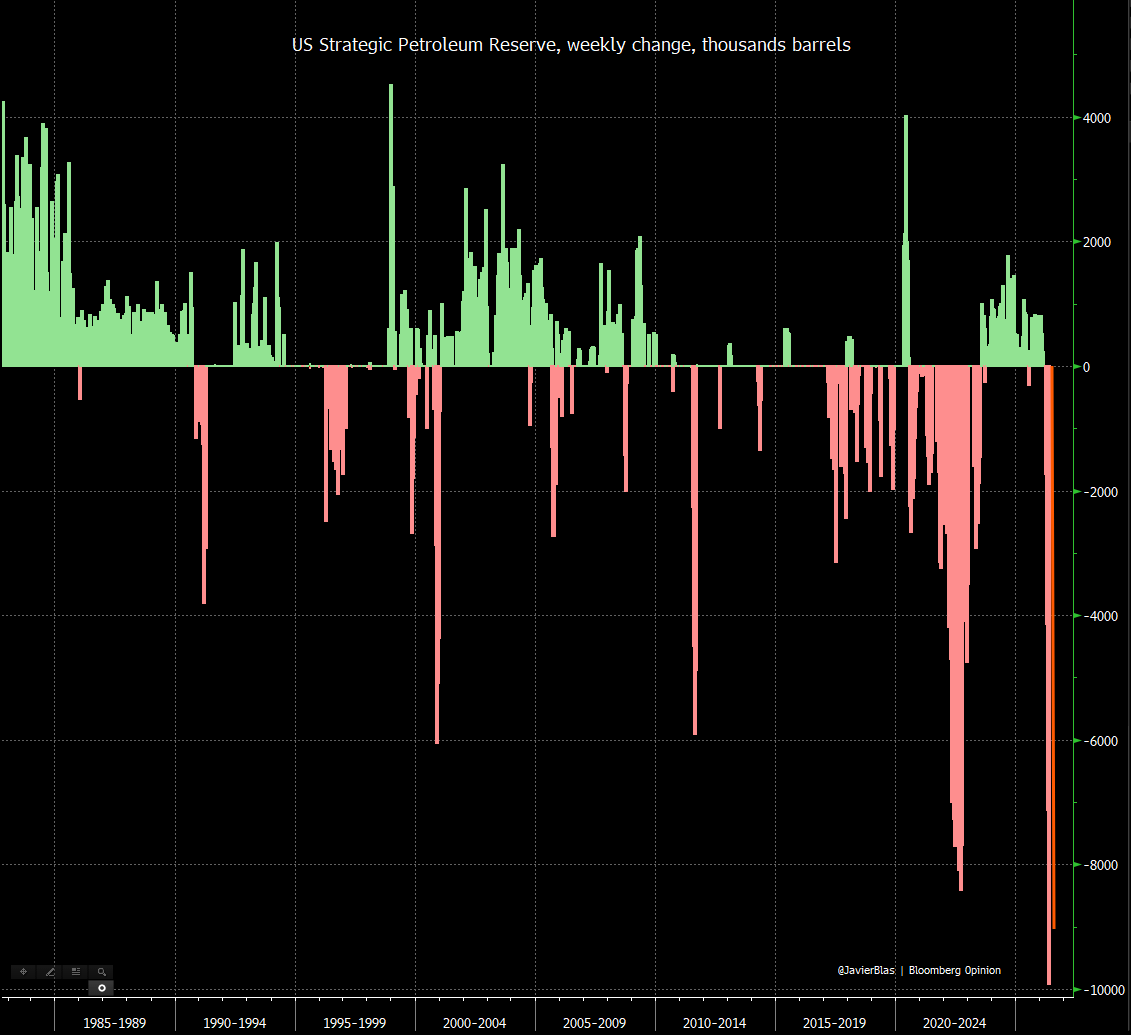
Source: Bloomberg, by way of Javier Blas. Look at the scale of those drawdowns! Bigger than even the Biden Administration efforts to mitigate the effects of the sanctions on Russian crude after the beginning of the Ukraine war before his own midterms.
As readers with even the most basic capacity for logical thought will have realised by now, none of these factors can last. Eventually, the Chinese refiners will run through their inventories. Eventually, the US SPR will run dry. Eventually, the oil in tankers and pipelines and local inventories will be used up. Only the open market will remain. Only the severely constrained spot market will be available. Here, it is important to reiterate that national reserves and inventories cannot go to zero — and that goes for the US SPR, too. Some oil must be left in pipes for them to work. Some must be left in the huge storage caves for them to maintain structural integrity.
Thus, right now, we are at that point in the Roadrunner cartoons where Wile E Coyote runs off the cliff but carries on running because he hasn’t realised the drop below. Top of this list is Europe. Jeff Currie is an oil market veteran famous for being right about bold, contrarian calls. Former Goldman Sachs and currently Chief Strategy Officer at Carlyle Group. Big hitter. He said earlier this week, in Singapore, that:
All of the inventories that are drawing out of the United States out of the U.S. SPR are being exported into Europe, so the Europeans think they have no problem because they’re getting all of this oil being imported from the United States, but that can’t continue on.
Asia is pretty much there already. Excluding China, Asia is on pace to import a record 1.94 million barrels a day in crude from the US. Imports of African crude are also approaching record highs, at some 1.7 million barrels a day. And yet refining activity remains 1.3 million barrels a day lower than the same period last year. This is causing wild gyrations in Asian prices, first in jet fuel and now in diesel.
But, as we have seen, this is in an environment that cannot last: the US will reach the point at which it is no longer able to export any more of its SPR. Nor will Chinese refiners have reserves to dig into. Asked about Europe, Mr Currie said “give it about another month, and look for July being a problem in the US.”
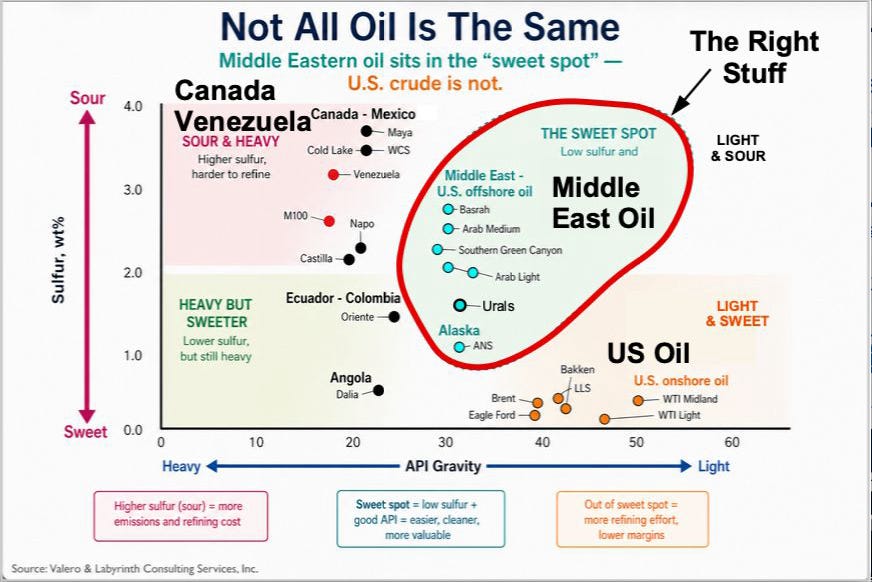
Yes, even he US! If you think that because the US is a net exporter it will be immune from this you are wrong. That is because not all crude oil is alike. It comes in different grades. You’ve heard the terms before: light, heavy, sour, sweet. Most US oil is light sweet crude. The stuff to which it now has access to from Venezuela is heavy sour tar-like sludge. What US refineries need is something in between, and that’s where the Gulf oil comes in, per the chart below.
Source: Art Berman (see above).
The global energy crash is still being papered over by gargantuan SPR draws and floating storage, but the physical plumbing is screaming warning signals. The usable buffer is gone. US driving season has started just now. European holiday season is a month away. The draw on refined oil products is about to surge across the developed world. Return your seats to the upright position and fasten in. Turbulence ahead.
Rubble Double, Toll and Trouble
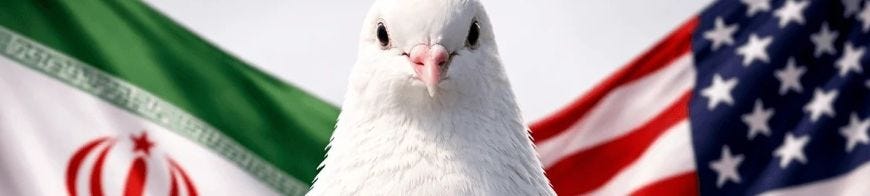
This, therefore, is the territory on which the negotiations are taking place. How are they going? If you listen to President Trump or US Secretary of State Marco Rubio, they’re going extremely well. Both have claimed, in their own way, that a deal is close. They’re going less well — much less well — if one is minded to judge based the actual details emerging from both sides.
For instance, the Iranian proposal is as follows (note well that these are approximations: it is always slightly different depending on the source, but we will attempt to aggregate the key points).
First, the US Navy will lift its blockade and all US military forces will withdraw from nearby Iran.
Second, Iran will transit through the Strait of Hormuz to pre-war levels, but that this will be achieved under the management of Iran and Oman through the newly established Persian Gulf Strait Authority (more on which later).
Thirdly, the a final peace deal is to be negotiated after this is agreed. If a final deal is reached within 60 days, it would take the form of a binding UN Security Council resolution. This would also lead to sanctions relief.
In addition, the Iranian side is looking for the US to release tens of billions of dollars of frozen Iranian assets just to sign this Memorandum of Understanding, which itself is ultimately just an agreement to start actual negotiations on a final deal. Tehran has further stated that its rights to enrich uranium and maintain its existing stockpiles are non-negotiable red lines. Sanctions relief must also come as part of any final deal. The head of Iran’s National Security Committee, Ebrahim Azizi, has put it bluntly:
Iran will not retreat from its red lines such as the right to enrich uranium, maintain enriched uranium stockpiles, management of the Strait of Hormuz, and lifting of sanctions.
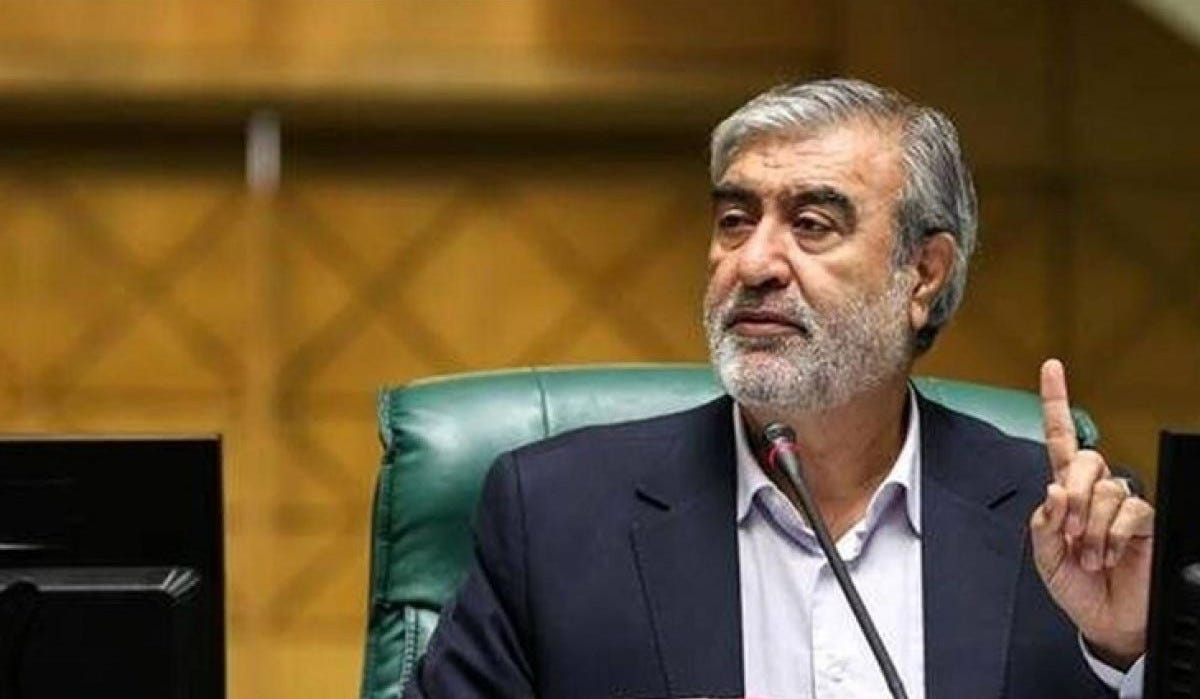
Ebrahim Azizi drawing a red line in the air
The leaks from the US side are, well, somewhat different. Immediate, unconditional reopening of the Strait to pre-war status — no Iranian “authority,” no tolls, no IRGC vetting. Verifiable moratorium on enrichment (Trump has floated “twenty years” as the baseline).
If these two versions are accurate (and they’re all we have to go on) they suggest that the two sides are as far away from an agreement than ever. They are not positions from which a landing zone can be ascertained: they are fundamentally zero sum. Either the Strait is international water with free naviation, or it is under some kind of Iranian control. Either Iran has an inalienable right to uranium enrichment, or it doesn’t. Where is the wiggle room for diplomatic finessing in the current positions?
For their part, the Iranians are simply moving forward. They have established the aforementioned Persian Gulf Strait Authority (PGSA), which requires shipowners to submit detailed manifests before transit is approved. The IRGC, and Iran’s Ports and Maritime Organisation and Supreme National Security Council, all have seats at the table. So will Oman, Tehran claims. Iranian officials have said they are drafting a joint protocol with Muscat to help “manage traffic” through the Strait — effectively giving Tehran a Gulf Arab partner for its PGSA system. Sultan Haitham has ratified new preferential trade, investment, and customs deals with Iran. Arial Oseran, Senior Middle East Correspondent i24news, even reports that Oman has also replaced the heads of some of its bank branches to expedite transactions with Iranian traders.
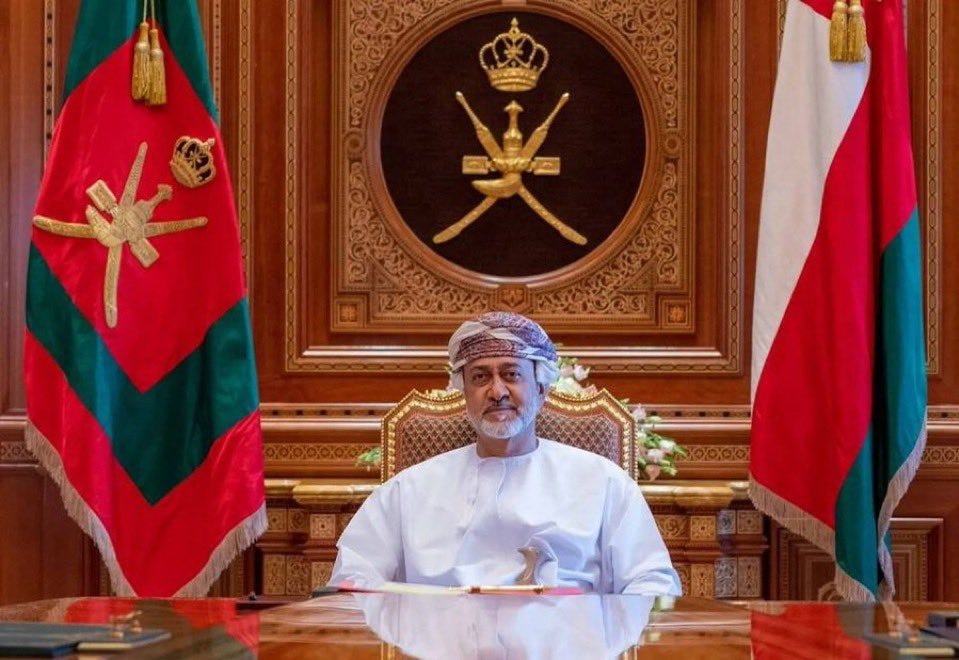
The Sultan of Oman. Apparently at risk of being blown up.
Washington is not amused. Scott Bessant has announced sanctions on the PGSA, calling it an “IRGC front.” He went further, threatening secondary sanctions on any company or state entity paying tolls or disguising them as “aid.” Mr Bessent also said that Washington would “aggressively pursue” anyone assisting in toll collection. President Trump was rather more blunt, as is his wont: “Oman will behave like everybody else, or we’ll have to blow them up.”
How close does that deal look now?
Bibi’s buzzkill
It gets even more complicated. Iran is bound to demand that any final deal includes a ceasefire in the Israel-Lebanon war. Israel, readers should not need reminding, has some influence here, and its attacks on Lebanon have actually increased in recent days. What’s going on?
The most obvious answer is that Israel is simply not done with its effort to neuter Hezbollah as a threat. There might be something more to this, however. It is well known — or at least as far as we can tell from the numerous, extremely clear, leaks, as well as the opinions of Tel Aviv’s many outriders in the US media — that Israel is against the US coming to terms with Iran before regime change in Tehran is obtained. Could Israel be using Lebanon and Hezbollah as a means to scupper any deal, knowing that the Iranians could not back down? Afterall, even if the President Trump managed to strongarm Benjamin Netanyahu to respect a ceasefire, they could always restart hostilities on the basis of self defence.
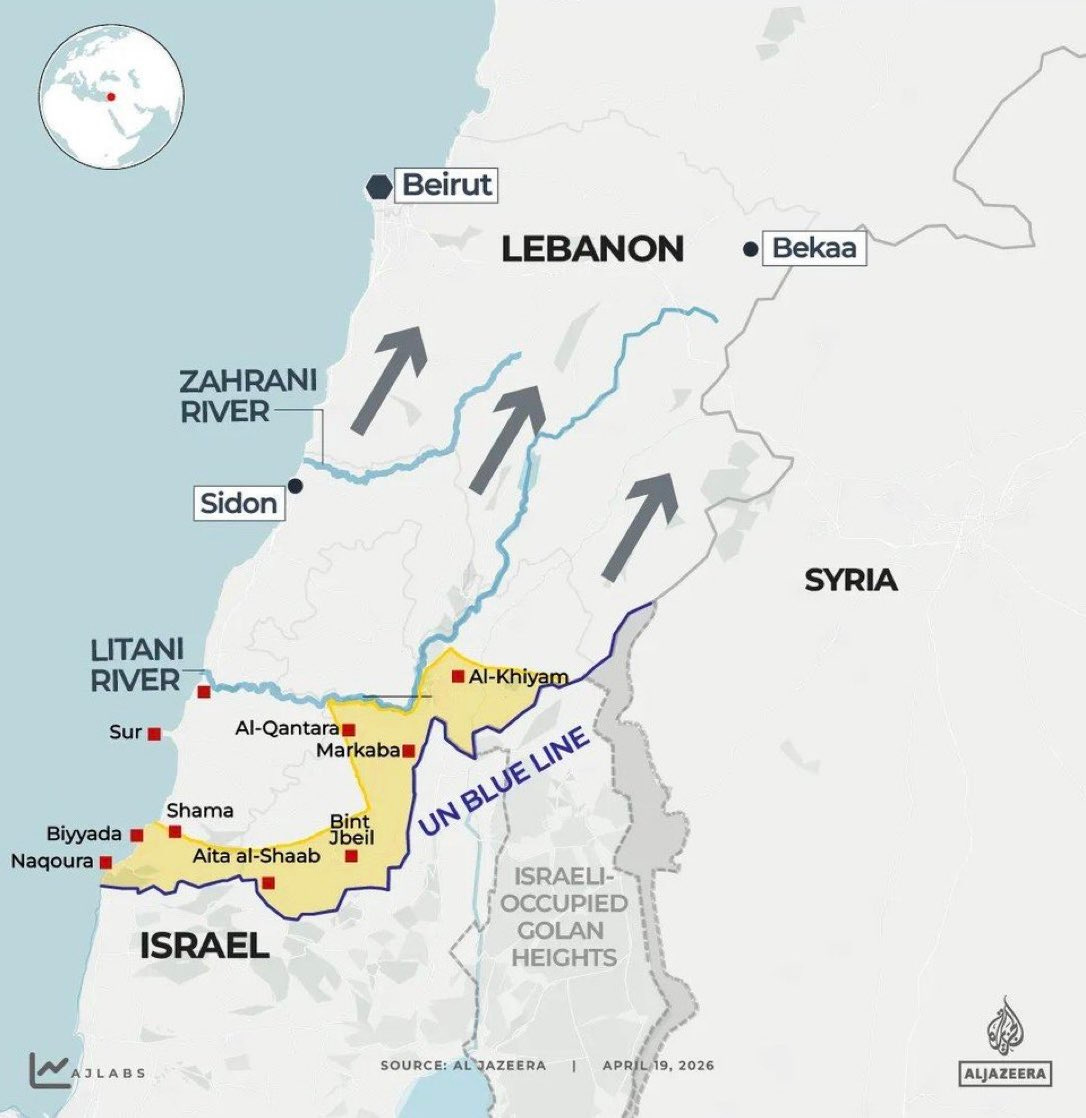
Israeli forces have moved beyond the so-called yellow line (albeit nohwere near as far as the arrows above suggest). Their efforts to neuter Hezbollah appear to have taken a fresh urgency and intensity. Why?
Trita Parsi, the co-founder and executive VP of the Quincy Institute for Responsible Statecraft, argues that in such circumstances:
Tehran would almost certainly pressure Trump to intervene and might even threaten to abandon the agreement altogether. But if Washington failed to act, would Iran truly sacrifice sanctions relief, economic recovery, and [return] to open warfare merely to register its objections? Moreover, walking away from the deal might not compel Trump to restrain Israel. Iran could end up with neither an agreement nor a ceasefire in Lebanon. In fact, it would be an outcome Israel would welcome.
Mr Parsi suggests that the likely response would be further attacks on the UAE. Abu Dhabi has openly hitched its wagon to Israel and the US. If the US allowed Israel to attack an Iranian ally, then Iran would attack a US-Israeli ally. Tehran would remain within the agreement while imposing costs elsewhere and putting the ball back in the US court.
This does not seem like a good outcome for the UAE. Yet is difficult to see where it has to go given the way it has anchored its foreign policy (see actions in Somalia and Sudan). An outcome in which Iran enjoyed dominance over its near abroad as a newly minted great power would not seem to be one the UAE’s ruling class would enjoy.
President Trump, meanwhile, threw another googly (American readers: see here). He demanded Saudi Arabia and Qatar, followed by Pakistan, Turkey, Egypt and Jordan, accede to the Abraham Accords. The Saudi reaction was icy. We must not forget that Riyadh already quietly torpedoed Trump’s short-lived Project Freedom plan to provide naval escorts for shipping in the Strait. It did so by denying the US use of Prince Sultan Airbase and Saudi airspace — a move that forced the abrupt U-turn in Washington. On joining the Abraham Accords, Riyadh simply stated that “there will be no normalization without an irreversible path toward the establishment of a Palestinian state.”
Yet president Trump is sticking to his guns. Again, how is the peace deal looking?
While the leaks about an impending MOU to end the conflict and start negotiations have pushed oil markets lower and triggered much optimism in the mainstream press, the substance of the leaks reveal two parallel universes. Iran wants to legitimise its wartime gains and keep the enrichment door open. Washington wants a mulligan, a kind of takesiebacksies where it tacitly admits the mistake of the war, but everything returns to the status quo ante bellum, and it can negotiate a nuclear deal with Tehran while cajoling the region’s Muslim states toward the Abraham Accords. Where is the room for these two visions to meet?
Here’s the bottom line: Iran has discovered it can sanction planet earth. We westerners have sanctioned enough countries to know how this works: it mostly takes time. Slowly, like a boa constrictor asphyxiating its prey, sanctions crush economies. That process is about to start in the west, as we explained earlier. The US military has proven unable to force Iran off the ball. Therefore the clock will continue ticking; the Hormuz boa constrictor will continue squeezing. Asia and Europe will be the first to start choking, but some time after, the US will, too.
Perhaps the first signs of serious economic pain are what it will take to keep the war hawks out of the room when decisions are made. Afterall, any deal acceptable to Iran would crystalise the US defeat and reveal a substantial and damaging strategic turnaround. May we suggest, then, that everything we are seeing now is a means of keeping the warhounds away from the White House door, giving the Israeli’s one last hurrah against Hezbollah, and figuring out a way to sell the big L when time runs out? Given oil prices, that is what the big brains in Wall Street seem to be betting on. The alternative is escalation. If that happened, oil prices would truly go lollapalooza.
Until the Clouds Roll in a Little…
Did you think the effort we put into researching and writing this dispatch brought you some value? Then take 10 seconds to subscribe for free right now. You’ll have noticed that far more articles are starting to appear here. The last couple have generated a stimulating and robust debate in the comments sections. We are delighted. If you want, you can support our efforts with a paid sub. This would also give you access to the secret society of our premium podcast episodes. A pretty, pretty good deal.
If you truly cannot spare the price of a few fancy coffees for a whole month’s content, would you do us a favour? Take just one minute of your time to share this with somebody who would benefit from reading it. Or maybe announce on social media how much you enjoyed it. We’d appreciated it greatly. Oh, and one more thing: do comment below. Don’t be scared. I’ll reply.
Multipolarity Brief apologises for the late arrival of this edition. An error in uploading meant it had to wait until after the podcast went live to avoid click cannibalisation. Letters of complaint to Andy Collingwood. The Brief will return no later than next Wednesday. Until then, farewell and good luck.
All about oil, but fertilizer (i.e. food) will be as big a deal for much of the world as oil
It seems like they will never reach a peace deal and the US is fine with dealing with the consequences of a global depression. One thing to also note about all this is how the US stock market is completely ignoring reality, we're told the current global economic order is the most rational and efficient yet it's heading towards explosive collapse with all the people in charge with their heads in the sand. We're truly in for some tough times as the old world order is dying