
Multipolarity Brief: Issue 7, Iran Special II
Trump Tactics, Mullah Masterplan; A Game of Drones; The Day the World Economy Stood Still; Conflict Termination

The break in normal programming continues. That’s because, sadly, so does the lunacy in Iran. Almost as sadly, despite the potential for economic disaster finally starting to sink in (several days after Multipolarity laid bare what awaited the Western world), the legacy media and mainstream talkingheads continue to peddle mostly superficial or outright terrible analysis. Therefore, alas, once again, Multipolarity will have do their job for them, providing the concerned citizen with a strategic explanation of events so far and a framework by which to view the conflict. Reading on will put you weeks ahead of most of your friends and colleagues — and, lamentably, the western commentariat.
Trump Tactics, Mullah Masterplan
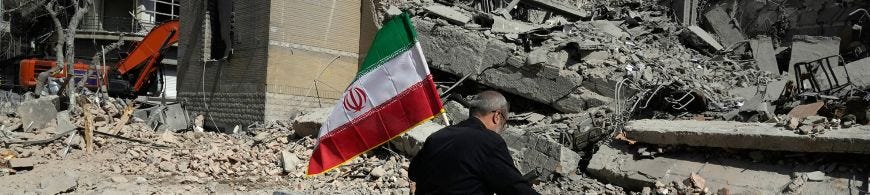
Repeat after me: tactics are not the same as strategy.
Tactics. Are. Not. The. Same. As. Strategy.
Understand? Let us try to explain within the context of what is happening in Iran. We are going to have to expend too many words to do this, but it is necessary because many commentators appear to confuse the two, and this confusion that is at the heart of the diametrically opposed assessments of the war provided by different analysts.
The US Air Force (USAF) and Israel Air Force (IAF) are striking Iranian targets. They are having success. They had the advantage of striking the first blow. First mover advantage in modern war is significant. To demonstrate this, imagine Iran had pre-emptively attacked US forces as they built up in the region, when fighter jets and tankers were packed tightly on runways (as Chinese satellite imagery showed, below).
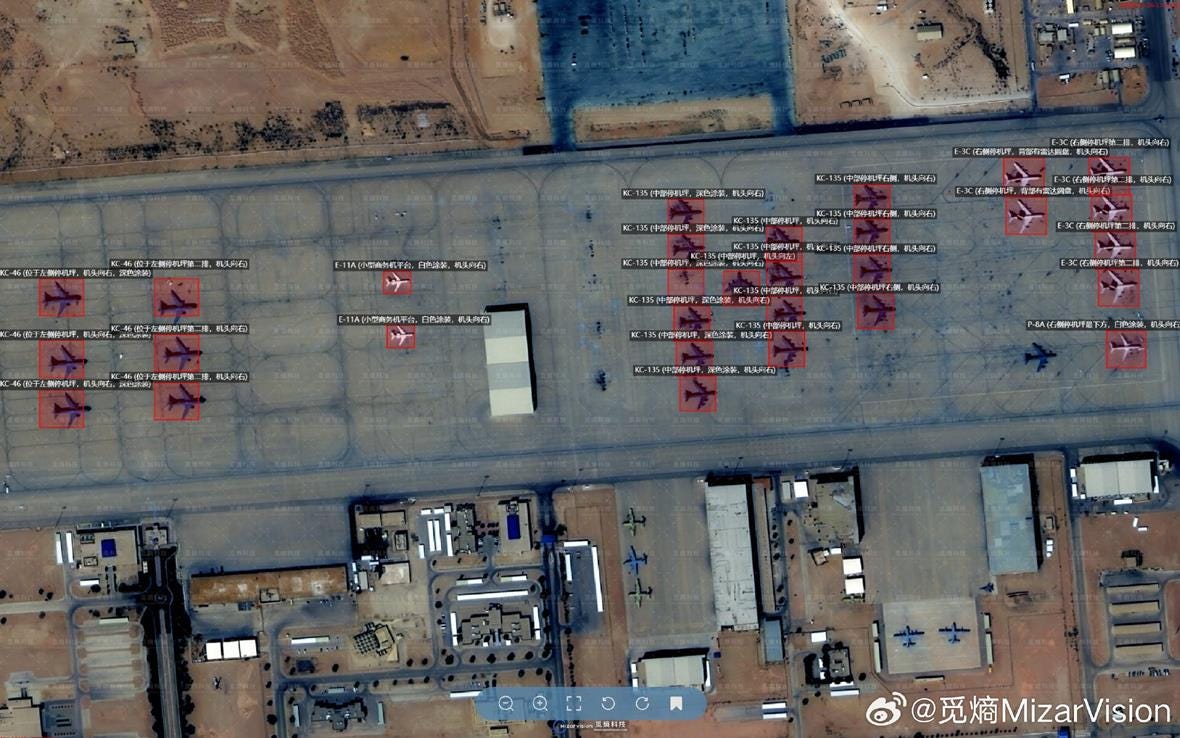
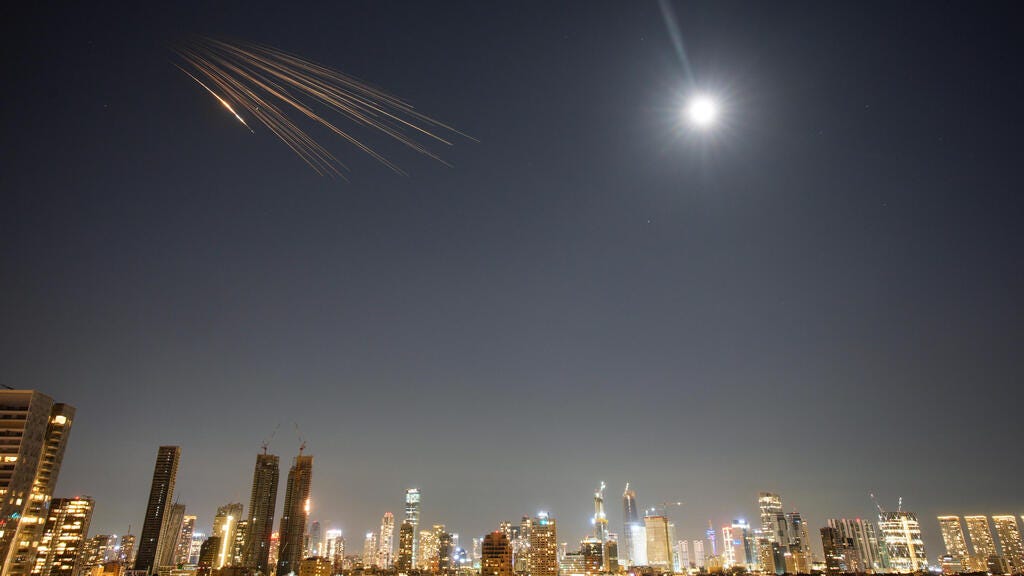
The idea that Iran was incapable of such an attack has now been thoroughly dispelled by its pinpoint strikes on US air defence radars. Now imagine what would have happened if Iranian missiles with cluster warheads of the type it has launched at Israel (pictured in the terminal phase, below) had been fired at the air bases like the one pictured above. Iran would have significantly degraded the ability of the US to undertake such Operation Epic Fury. Depending on the success of an Iranian pre-emptive strike, the US-Israeli operation might have been delayed while replacement forces were brought into theatre. Even if this was unnecessary, the USAF would have to have sortied from bases beyond the range of Iranian missiles, reducing the operational tempo they could maintain.
None of this is a criticism of Iran. Nor a glib effort to create a ‘what if’ fantasy. It is simply a means of demonstrating that in modern warfare, he who moves first has a huge advantage. In reality, however, Iran was on the strategic defensive, which meant the US and Israel could move first. There should be no doubt that they scored tactical victories in those first days — killing many of Iran’s senior political, military and intelligence leaders, and destroying some of Iran’s capacity to fire back. The economic toll they are exacting from Iran is huge. The US and Israeli militaries continue to score such tactical victories and will do so in future. No serious commentator would doubt this, and we should exclude from our consideration anybody who does.
Yet these wins have been tactical, not strategic. At the beginning of the campaign, the Trump Administration stated its aim was regime change. As Multipolarity explained in last week’s Brief, the US has no means of achieving this through air power alone. Reality has, so far, supported our claim: the aforementioned tactical wins have not led to the achievement of the Washington’s strategic objective of regime change. Indeed, judging by the ostentatious and large scale displays of solidarity within Iran, they might have had the opposite effect. Multipolarity contends that Washington can obtain regime change only if there are proxies on the ground willing to do its bidding. (Whether regime change is in fact the strategic aim of the US and Israel is a question we also addressed in this section of last week’s Brief and will continue to discuss below.)
Meanwhile, Iran’s strategic aim is to make the United States and Israel halt their attacks, and further to ensure that they will not attack again in the short or medium term. To this end, they have eschewed a counterforce (military-on-military) battle, and have instead focused on waging a countervalue war. In short, Tehran hopes to inflict sufficient pain, either through attacks on allies, or through the economic channel, to make the US and Israel stop and to dissuade them for coming back for another bite of the cherry anytime soon. The key point here is that Iran’s tactical wins have moved it closer to its strategic end. It has destroyed several US radar installations and US bases in the GCC nations. This makes each of its remaining missiles and drones more valuable, because they are more likely to score hits that cause pain to the US in future. And it is already causing pain through its missile and drone attacks on the Gulf states and Israel, and especially by choking off the supply of oil from the region. This pain is clearly already being felt, with numerous reports over the weekend and yesterday revealing that ‘sources’ in both the US and Israel are wondering whether acceptable offramps can be found.
Can we now see the difference between the concepts of the tactical and strategic insofar as they apply to this war? Can we now see how the USAF and IAF scoring tactical win after tactical win in Iran does not (necessarily at least) mean it is ‘winning’?
A Game of Drones

The Iran war has thus become a race: can the US and Israel degrade Iran’s ability to fire missiles and drones before the pain inflicted on the world economy and local US allies becomes so great that Trump will have to call off the fighting. As Multipolarity Podcast co-host Andy Collingwood wrote on X (formerly Twitter) on 5 March, “A world in which the US declares victory and moves on while Iran is still firing missiles at US allies within the region is a world indistinguishable from US strategic defeat.” As we wrote in last week’s Brief, conflict termination is therefore no longer a unilateral decision in Donald Trump’s hands.
Here, there should be cause for great alarm in the halls of US power. The general idea of US air doctrine in Iran is as follows. As the USAF degrades Iranian air defences (such as they are), its fighters and bombers will be able to penetrate deeper into Iran, and spend longer over target. This would allow the USAF to more effectively degrade Iranian missile and drone launch capacity, which would be destroyed at an ever faster pace. Iran would thus fall ever farther behind the necessary force maintenance/replacement rate, and its fighting power would decline on an exponential trend line.
How achievable is this? Anusar Farooqui, the strategic policy analyst, has created a model on his Policy Tensor Substack that shows how “daunting” the “the mechanics of the drone war are” for the US military. He contends that “the crucial variables… are the rate at which the US can degrade Iranian drone production sites… and the rate at which the Iranians can rebuild and repair the same.” He continues that “This ratio controls the dynamics of the rate at which Iran can sustain counter-value attacks across the gulf and the length of time it can keep Hormuz closed.”
Multipolarity urges the more mathematically or econometrically minded readers to read the full paper and examine the model for themselves. Key for our purposes, however, is that the model suggests that, “Even in the highly implausible extreme scenario where Iran cannot reconstitute any production sites and the US degrades them at the rate of 90% per month, Iran can still sustain a high rate of fire for four months.” The charts below are from Mr Farooqui’s paper. They show his realistic worst case scenario for Iran.
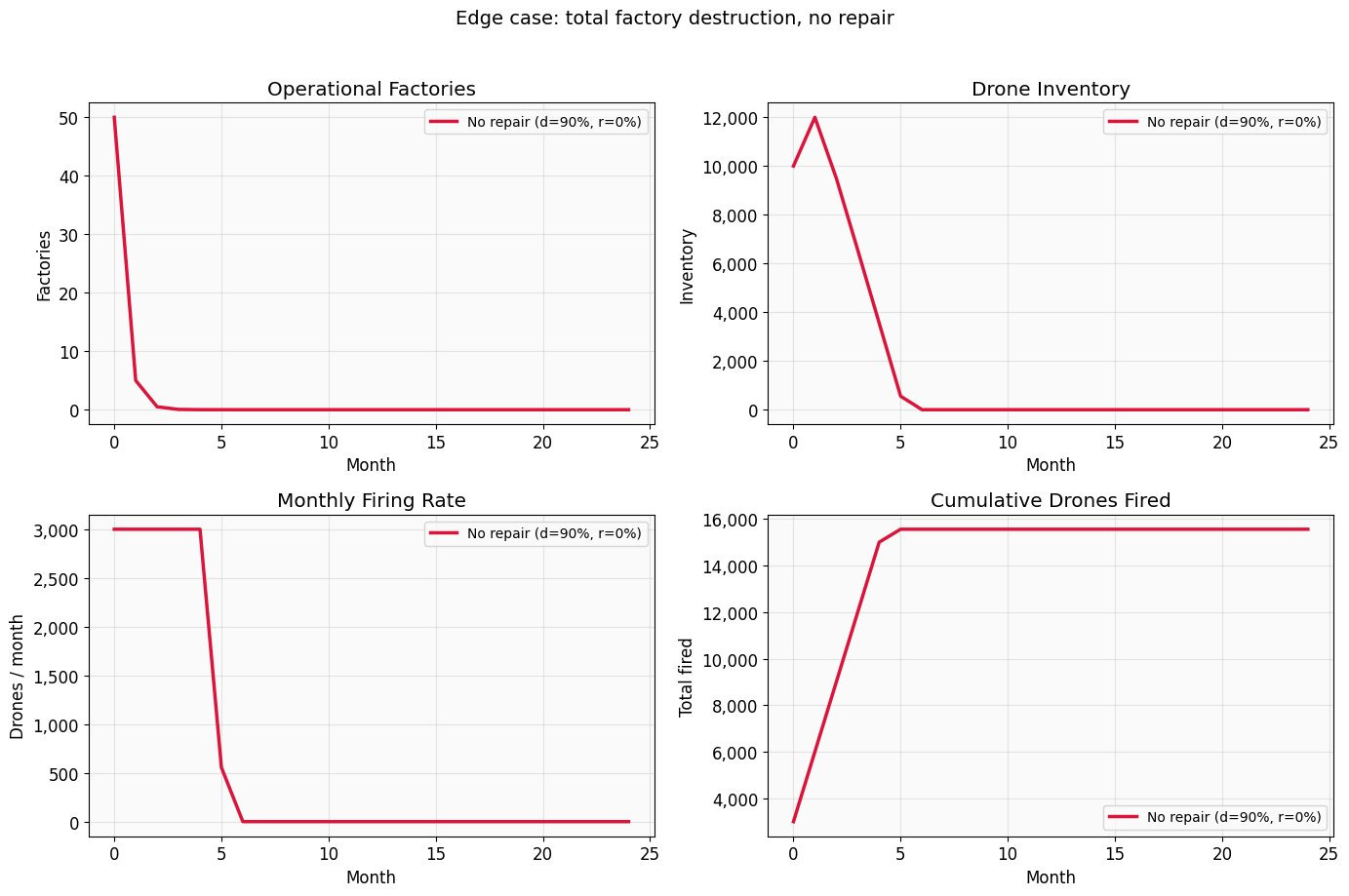
As Mr Farooqui points out: “If Iranian capabilities cannot be degraded for at least four months, the costs to the world economy and the United States would be intolerable.”
The Day the World Economy Stood Still
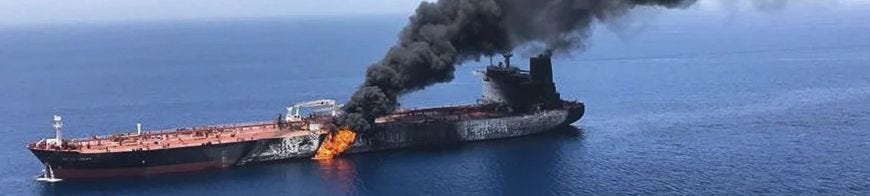
It is not hyperbolic to suggest that the costs to the global economy of a four month campaign would be ‘intolerable’. In fact, it is a gross understatement: it would be a catastrophe, far exceeding the damage done by the Global Financial Crisis in 2007-8. Craig Tindale, a private investor, has written a deeply alarming analysis of the cascade effects likely to ripple through the world economy if the Strait of Hormuz remains closed for very long. He comprehensively dispels the commonly held notion that the effects would be ‘limited’ to the oil market and thus the cost of energy.
Instead, Mr Tindale argues that what appears to be a maritime blockade is, in reality, the exposure of “the entire global system as a hierarchy of brittle interdependencies.” He shows that the lack of oil and LNG from the Gulf ultimately means a failure of the foundational inputs for “electricity, fertilizer, shipping, chemicals, mining, manufacturing, and state finance.” For instance, the “global polyester chain begins in petrochemicals. A severe disruption to hydrocarbon and petrochemical feedstocks cascades into PTA, MEG, polyester resin, filament, and fabric production, causing acute shortages, price spikes, and factory stoppages across synthetic-heavy apparel segments. The industry does not vanish overnight, but the low-cost, high-volume apparel model starts to break down.”
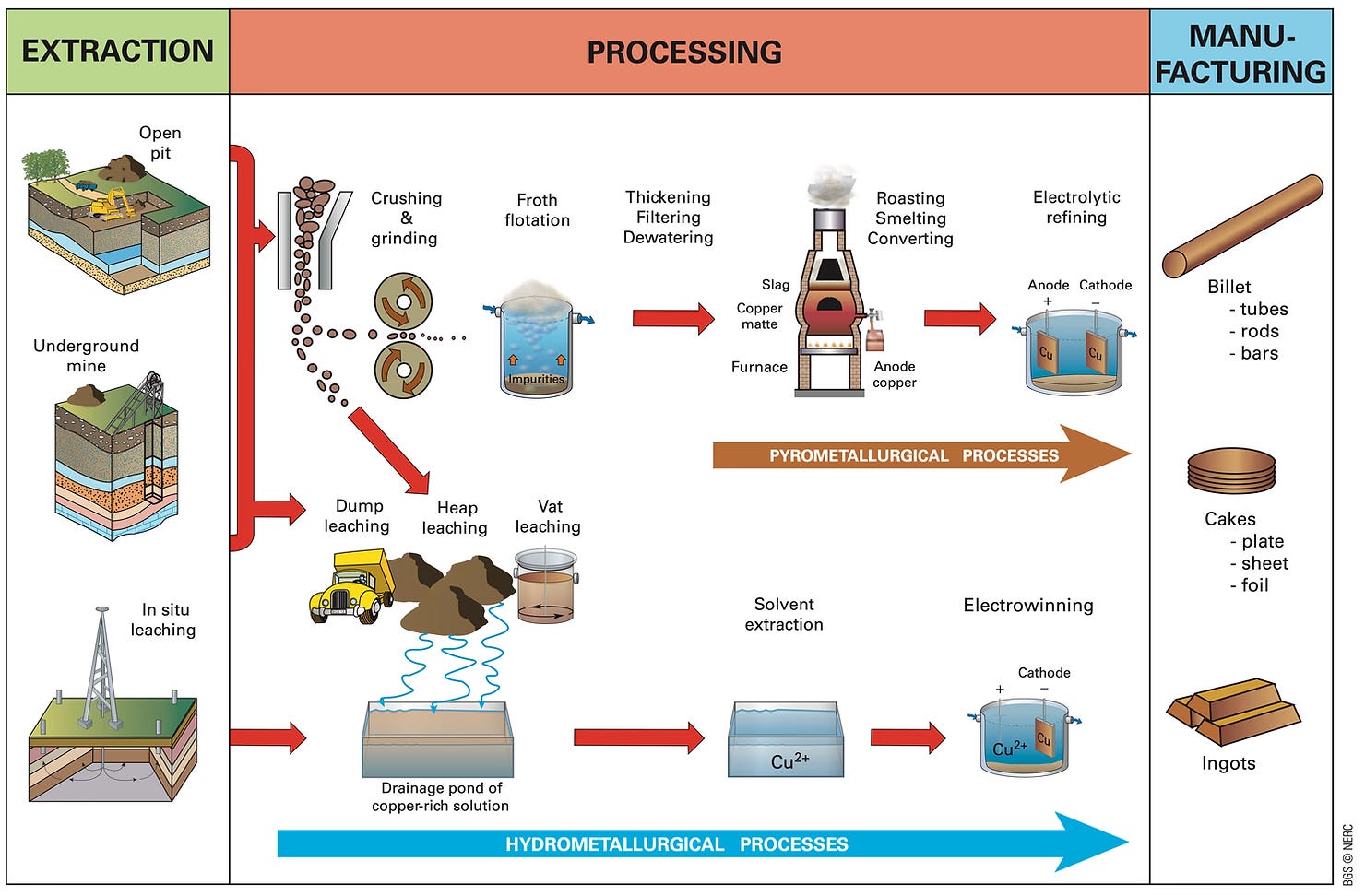
This applies to food as well as clothing. “The global nitrogen fertilizer chain begins with natural gas. If gas supply is disrupted, ammonia and urea production falls, farm input costs spike.” Which means much higher food costs. The list continues. Copper and cobalt extraction depend on the production of sulfuric acid (see image below, ‘heap leaching’ and ‘solvent extraction’), the main input of which is sour crude. As copper becomes more expensive, electricity grids can no longer expand or be repaired at affordable, prices.
Similar cascades, Mr Tindale shows, also affect propylene production (and thus hospitals, food packaging and carmakers), chlorine and caustic soda manufacture (and thus water treatment, PVC production and paper manufacture), the rubber industry (and thus tyres and thence the freight industry), steelmaking (and thus most modern construction), aluminium smelting (and thus cans, aircraft, cable and vehicle parts), the glass industry (and thus the manufacture of windows, windshields and solar panels), and the high purity gases and chemicals required for the fabrication of semiconductor wafers and microchips (and therefore just about everything in the modern economy). Each of these problems, in turn, slam into other parts of the economy, and do so at the same time.
Quite correctly, Mr Tindale argues that this would produce something like “a global Arab Spring,” as populations experience the breakdown through “unaffordable bread, intermittent power, empty pharmacies, and possibly the collapse of public order.” Importantly, the effects of this would be non-linear, and thus almost impossible to forecast. It would hit “every household budget and every state ledger at once. The result is the destruction of planning itself: firms cannot quote, governments cannot subsidize, and populations can no longer calculate the future. Under such conditions, credit markets seize up, foreign-exchange reserves drain, sovereign spreads widen, and the boundary between economic crisis and political crisis disappears.”
Mr Tindale estimates the effects of a full closure of the Strait would take different times to obtain through different cascades. Some, like reduced LNG supply, would happen immediately, and we are already seeing the effects through higher energy prices. Others, like the production of metals like copper, would take up to three months. Yet others would take up to a year. It should, however, be clear to Multipolarity Brief readers that Anusar Farooqui’s contention that the economic effects of a full closure would be “intolerable” was correct in the truest sense of the word. In fact, Mr Tindale describes it thus:
It is the transition from a globally integrated commercial order into a world system governed by scarcity, coercion, and administrative triage. In such a world, hunger, hyperinflation, sovereign failure, technological stagnation, and geopolitical militarization are… normal operating features.
Conflict Termination

What can be done? There are only three possible outcomes. Option One: the US succeeds in supressing Iranian fires, starts combat air patrols over Iran, and either somebody seizes power in Tehran and submits to Washington’s demands or the Iranian state functionally collapses. Option Two: the aforementioned multiple-channel cascade effects ripple through the global economy sufficiently for US allies, and the elite in Washington, to force the Trump Administration to halt operations. However, as aforementioned, this is no longer a unilateral decision for the US. We discuss what this means later. Option Three: the US and Iran could negotiate a ceasefire or, more likely, a full peace treaty.
Let’s take option one. Let’s say that Mr Farooqui’s modelling is erroneous and the US can supress Iranian fires in relatively short order. What would a leader who wanted to “unconditionally surrender” to Washington (per Mr Trump’s recently stated demands) have to do? First, amid the chaos, such a leader would have to seize power in Tehran, grabbing what remains of national government control and the physical infrastructure still standing. Then, because the Iranians have installed the Distributed Mosaic Defence, he would have to somehow assert authority over all the distributed, autonomous military, intelligence and civilian units to which power has been devolved. In other words, he would have to reconstitute the centralised control that has been dissolved.
Secondly, if he somehow achieved that, he would have to turn to the population. Recall the postwar history of Iran. It was preyed upon by the UK and the US. It then had a revolution, and not one like Iraq or Syria. Iran fundamentally saw itself as a revolutionary vanguard state, and one with religious theocratic rule at its constitutional and cultural core. A new leader would have to persuade the Iranian people that all that had been a terrible mistake. He would have to persuade Iranians that it had led to catastrophe; it led to being bombed to pieces. And the solution, my fellow citizens, he would have to say, is to not only make peace with the nations that are currently bombing our schools and hospitals along with our military, but for the foreseeable future to run our affairs in their interests, which are now yours. To that end, we will have to give up our means to ever defend ourselves in future, allow the US, and perhaps Israel, the UK and France, to run combat air patrols over our territory, share intelligence and internal security information with the US and Israel, and allow them to militarily interdict our people on our territory, as they see fit. We will also have to pass the legislation that they want — probably to control our natural resources, per President Trump, and as has happened in Venezuela.
Does this seem likely? Not remotely. Multipolarity Brief would love to read intelligent analysis in the comments section of the mechanics of how such a regime change could be obtained, because a Delcy Rodriguez figure emerging in Tehran seems highly unlikely to us.
The other option for a scenario in which the USAF and IAF supressed Iranian fires, of course, is state collapse. Last week’s Brief explained why this would lead to more Western involvement, not less, and more instability, not less. Per Professor Robert Pape of the University of Chicago, as Iran fragmented, so risks would multiply. There would be no central control to prevent piecemeal attacks on the Strait, or the multiplication of terrorist organisations. Meanwhile, the security of Iran’s nuclear material becomes impossible to guarantee. Regional instability would become worse as ethnic tensions and chaos spilled out beyond Iran’s borders. Hundreds of thousands — or perhaps millions — of people would seek to emigrate from Iran. The fear of rival great powers taking advantage of the vacuum in Iran would heighten.
Thus, in the event of the breakdown of the Iranian state, the Washington’s geostrategic and economic interests, and the interests of allies, would demand and require further and permanent US involvement.
Neither of these outcomes seems likely or like an unambiguous strategic victory, respectively. In his aforementioned paper, Anusar Farooqui suggested that the US could attempt to impose order and its will through occupation; however, he then showed just how unlikely that would be. “In order to achieve the same force-to-space or the same force-to-population ratio as Iraq,” he wrote, the US would “have to deploy 600,000-1,000,000 troops.” This, Mr Farooqui argues, would consume the entirety US military strength, even if it could stage such an invasion force unmolested (doubtful) or had the capacity to even transport them to staging grounds (an open question given US force readiness and scale) or had the appetite for such an operation (it does not: imagine the political ramifications in the US!)
Incursions by the Kurdish, Azeri or Baluch ethnic groups seem off the table for now, given public announcements by these groups. But even if they were not, how would carving out ethnic statelets prevent the Iranians making Gulf transit uninsurable, and thus preventing passage? Meanwhile, a full civil war in which Iranian military capacity was turned inward returns us to the problem of state fragmentation.
The afore going logic suggests that option one, a US strategic victory, is highly unlikely — even in the event that the US can knock out Iran’s capacity to fire back. Yet, as we have seen, modelling of the drone and missile war shows that this is a questionable prospect anyway, bringing us to Option Two: the US is forced to withdraw. This option includes the glib and shockingly misplaced notion of some US commentators that “Trump could just declare victory and move on.” In this scenario, Iran would wish to impose conditions that gave it some reassurance that the US and Israel would not attack again in six months or five years. It would have, through its control of the Strait and its ability to hit US allies in the region, significant leverage to demand such terms.
Yet here again, we run into a conflict termination problem. Given the subterfuge Israel and the US used to gain tactical surprise for their attacks in the Twelve Day War and Operation Epic Fury, respectively, which involved using negotiations as cover for, and to aid, decapitation strikes, it seems Iran would be highly cautious about taking Washington’s word for it. It would likely require concrete steps, such as the removal of all US bases from the Arabian Peninsula and a new regional security architecture. It is difficult to exaggerate what a strategic turnaround this would be. It would be a devastating blow to the US global position and its prestige. It would also, as Mr Farooqui wrote, destroy the Trump Presidency immediately and the Republican Party for the foreseeable future.
For these reasons, it seems unlikely that there will be a TACO moment soon, despite high oil prices and increasing signs that both Israeli and the US are growing concerned. Instead, we believe it more probable that the US would continue operations — perhaps even increasing its risk tolerance — until more extreme economic pain is felt. Especially as it is, as we have said, continuing to score tactical victories.
And, thus, we have also addressed the third possible outcome, a negotiated solution.
It is hoped that this demonstrates the difficulty of the fix the US is in. Can anyone slice the Gordian Knot?
There are other, broader consequences. For instance, Taiwan is now lost to the US, even before this war continues. But we will address that in a future dispatch.
Until the Clouds Roll in a Little…
Did you think the effort we put into this brought you some value? Then take 10 seconds to subscribe, for free, right now. Take another ten to share this with somebody who would benefit from reading it. Oh, and if you like a killer deal, for only eight bucks you can subscribe to Multipolarity the Podcast on Patreon. In return, you’d get all our premium podcast episodes, including the back catalogue (in which there are some absolute gems). Knockout deal!
Multipolarity Brief will return next Tuesday. Until then, farewell and good luck.
Excellent strategic framework, particularly the distinction between counterforce and countervalue warfare. One dimension worth adding to the "Day the World Economy Stood Still" section: the financial mechanism that makes the Hormuz closure binding isn't military enforcement alone — it's insurance market collapse. Over 50% of P&I clubs have canceled Gulf war-risk coverage entirely. Premiums for remaining coverage have surged multiple-fold overnight. The US Development Finance Corporation has deployed $20 billion as what amounts to an insurer of last resort — the first institutional admission that private markets cannot price this risk. This means even if the US were to militarily "clear" the Strait, commercial shipping can't resume until the insurance infrastructure reconstitutes. That's a weeks-to-months timeline regardless of military outcomes. It's the financial layer that transforms the tactical-vs-strategic framework you've laid out from a military question into an economic fait accompli.
Very good piece. This isn't a criticism of you, but an additional point is that too little is made of any potential divergence of agenda between the US and Israel.
Trump may want Venezuela-redux, which a pliant central leader selected from the regime, but Netanyahu would prefer Iran to no longer be a functioning polity, and Israel is not just a 'plus support' akin to UK in Iraq.
It makes the ending of this war even less within Trump's discretion than you outlined.