
Multipolarity Brief: Issue 8 — Iran Special III
We misunderestimated them; Gordian knot tangles up Trump; The ultimate escalation.

No return to normal programming. The mainstream media and foreign policy analysts are still offering, for the most part, delusional or otherwise bad takes. Therefore, yet again, we will have to do their job for them. As always, the Multipolarity Brief will offer a strategic explanation of events so far and a framework by which to view the conflict. Giddy up!
We Misunderestimated Them

The United States of America faces strategic defeat in its war against Iran. This much has been clear for at least a week. While the US Air Force (USAF) and Israeli Air Force (IAF) have won numerous tactical victories — in killing large swathes of Iranian political, military, religious and intelligence leadership, in smashing Iranian central command and control infrastructure, in destroying some of Iran’s missile capacity and in damaging the country economically — these have not moved Washington closer to its strategic aims. Meanwhile, Iran’s fewer, but still significant, tactical victories — have moved it closer to strategic victory.
Here, it is important to highlight one of the revelations of this conflict: the quality and competence of Iran’s Reconaissance-Strike (RS) complex. RS refers to the ability to surveil the enemy, use the intelligence gathered to select targets, and then attack them in a manner timely and accurate enough to score kills. This is yet another way in which Iran was underestimated pre-war. Satellite imagery of US bases and radar installations (satellite imagery below) have shown a mature and effective precision strike capacity. This much was expected, given the democratisation of precision strike is now an old story.
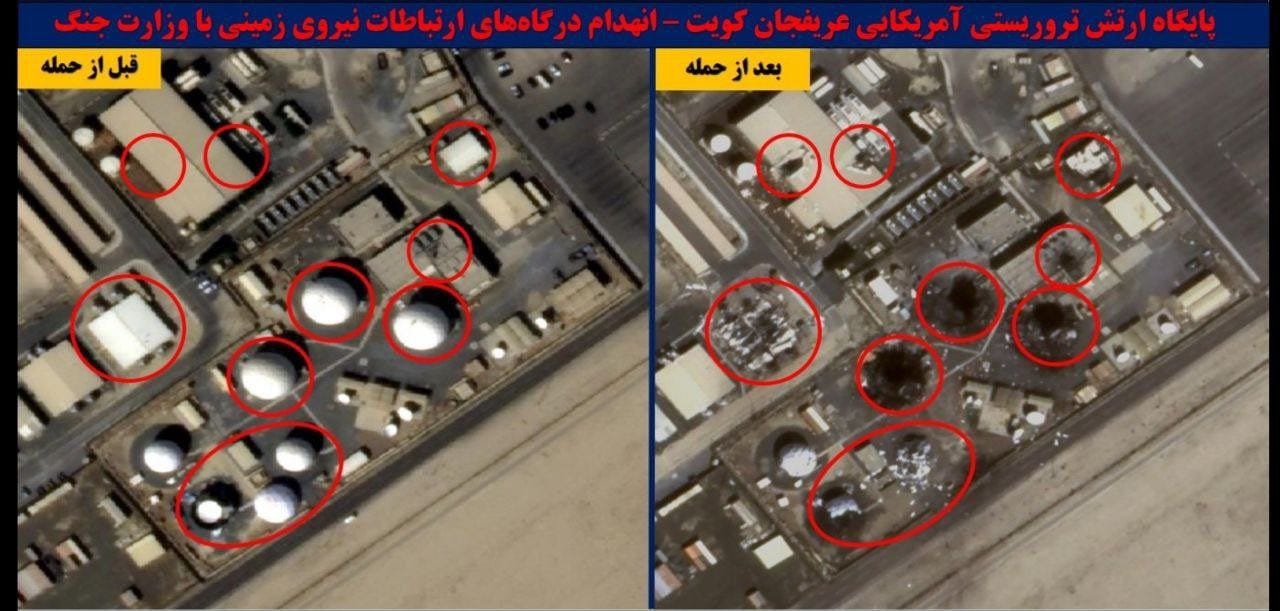
The US Ali Al Salem Air Base in Kuwait. The right hand picture shows pinpoint attacks on radar dome enclosures, as well as to surrounding buildings. The absence of significant damage to the rest of the area suggests accuracy. This picture has been independently verified as non-AI. The damage to the Ali Al Salem base has been verified by ABC News and the New York Times.
Less well understood was Iran’s ability to link precision strike with the intelligence and targeting components in a sufficiently timely manner to score single shot kills against mobile or fleeting targets. Evidence was first seen in the bullseyes on the radar systems that allow the US THAAD batteries to work. These are hugely expensive, top-shelf air defence systems — what President Trump might refer to as the ‘exquisite class’ of weaponry.
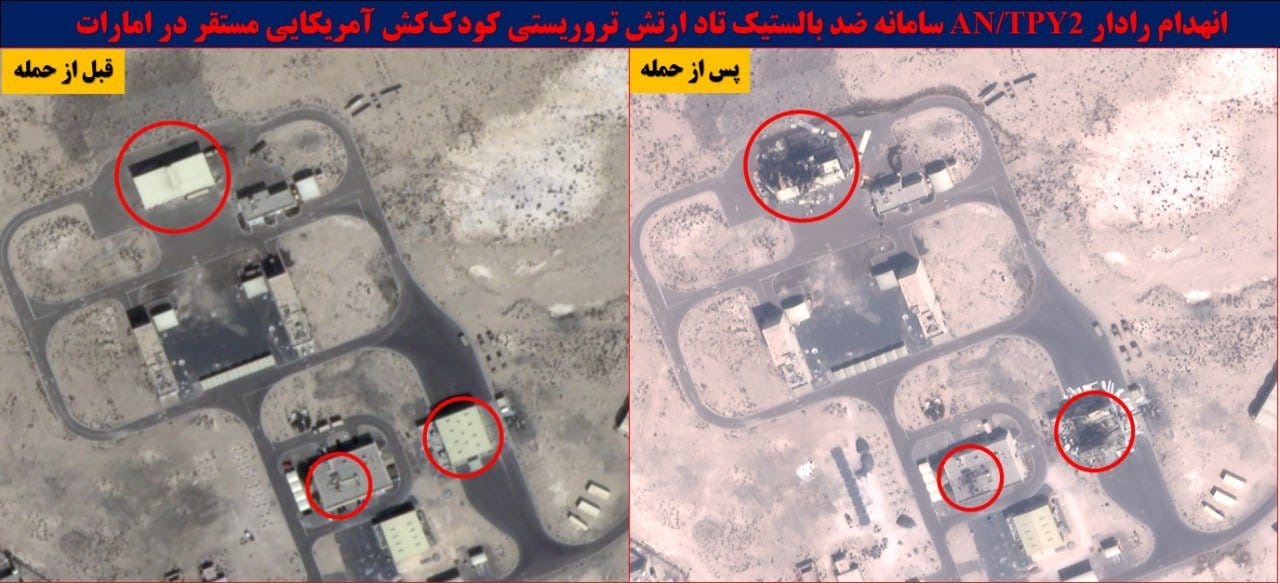
The destruction of an AN/TPY-2 radar system, used in support of the THAAD air defence system, in Al Sader, UAE. The United States has few of the hugely expensive THAAD air defence systems, and only 13 of the AN/TPY-2 radars in its entire inventory. This picture has been independently verified as not AI generated.
The clincher to our new understanding of Iran’s RS complex was the drone assassination of Arnaud Frion, a French soldier serving in Iraq. This strike required a short turnaround from intelligence gathering to hit (including flight time). Such kills are the sort we expected of the US and Israel, not Iran. It bears repeating: Iran’s reconnaissance-strike complex was underestimated.
Crucially, these tactical successes have, unlike those won by the USAF and IAF, moved Iran closer to strategic victory. This is because the US theory of victory involves regime change, while the Iranian theory of victory involves imposing enough pain on US allies and the global economy to compel the US to halt military operations against Iran. (We explained this in depth in last week’s Brief. New readers should review that detailed analysis before moving on.)
The only way the US can obtain victory is through the successful destruction of Iran’s capacity to fire missiles and drones at US allies, shipping through the Strait and Gulf oil infrastructure. We are now approaching three weeks into the campaign, and the USAF and IAF has not achieved this. Furthermore, since the last Brief, the prospect of victory appears (with all the usual caveats regarding the fog of war) to have moved father away rather than closer. Iranian drone and missile strikes appeared to have dropped off before our last Brief. Since, they have been steady. US heavy bombers are still being loaded up with precious JASSMs, standoff cruise missiles, rather than cheap and almost infinitely plentiful guided gravity bombs.
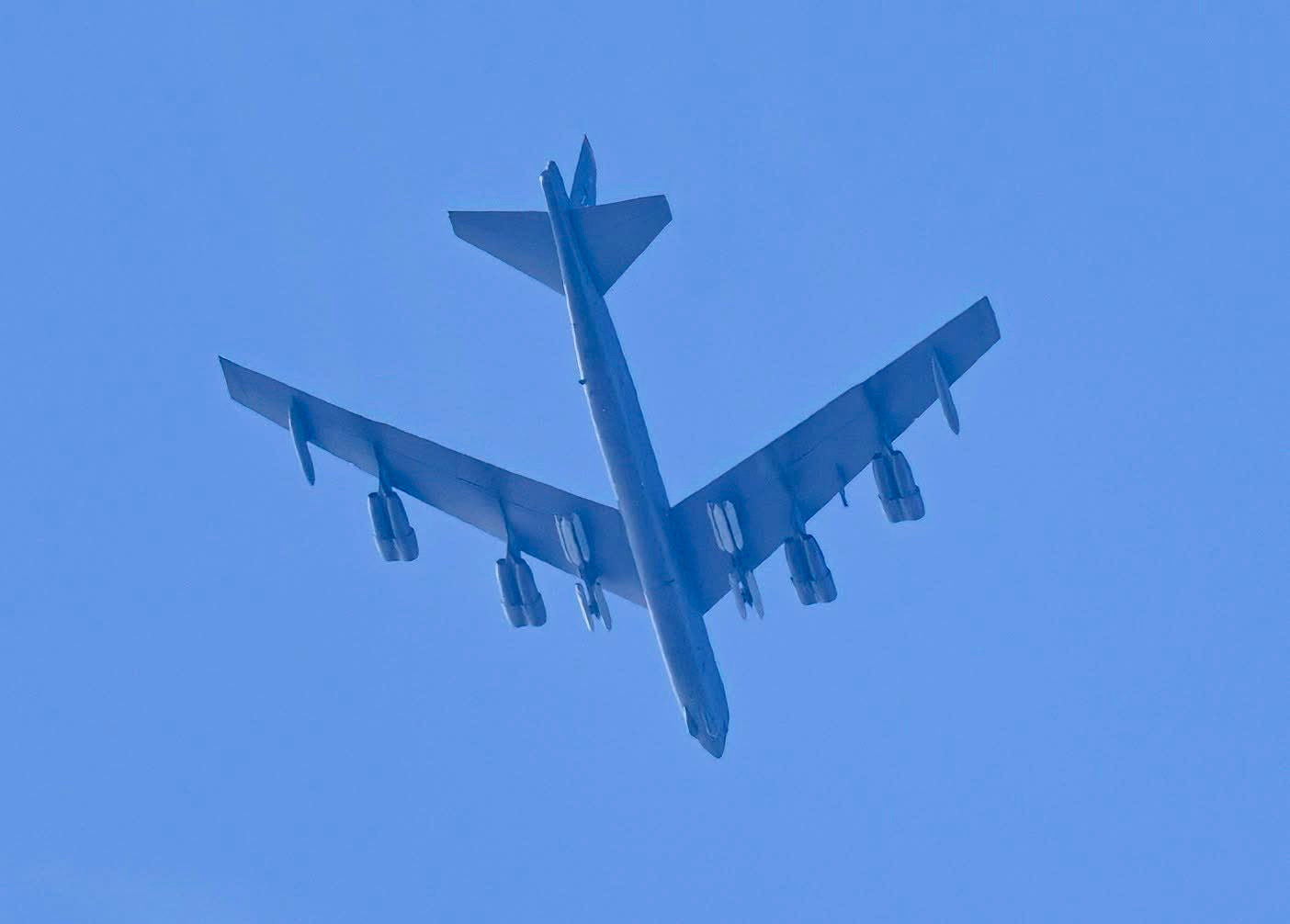
A USAF B-52 heavy bomber photographed on the morning of 15 March heading to Iran. Note that there are at least five white cylinder shapes under each wing near the fuselage. These have been identified as JASSMs, stealthy cruise missiles that can deliver a 1000lb warhead from at least 230 miles away. The continued use standoff weapons suggests that the USAF has not secured persistent air superiority over Iran, over two weeks into the conflict.
Finally, the destruction of US bases in the region is pushing the USAF farther away from Iran. This makes it more difficult to maintain sortie intensity. In other words, in the ‘Race of Drones’, the US is moving too slowly: it thus seems, at the time of writing on Tuesday, 17 March, and applying the aforementioned caveat, that the economic pain will become intolerable for the global economy and the US’s local allies before Iran’s ability to fight has been exhausted.
Gordian Knot Tangles up Trump

Even Donald Trump, with all his undoubted cunning, and genius at media manipulation, cannot simply walk away from this. (We detailed the conflict termination problems the Trump Administration faces in our last dispatch; new readers should parse it before moving on.) In brief terms, a world in which the US withdraws while Iran is still firing is a world indistinguishable from one in which Washington has suffered a strategic defeat. Why? Imagine what would happen. Opening the Strait would remain be favour at Tehran’s grace; Gulf Cooperation Council nations and Israel would remain under air attack. Everybody would have to ask Iran for its terms.
President Trump would therefore need a deal to be able to leave. The problem is that in any negotiations that took place now, Tehran would have enough leverage to demand a package that would be both politically unpalatable for Trump while looking much like the strategic defeat briefly outlined above. So, if the current tactics are not moving the US quickly enough toward strategic victory, and politically palatable conflict termination is off the cards, what can be done? Escalation. Multipolarity therefore believes that it is probable (but, to be clear, not certain) that the conflict will soon escalate to a new and more dangerous phase. The problem, as we shall see, is that all of the most likely escalatory options would most likely make Washington’s strategic position worse, not better.
There are four main options. First, escalating the air campaign to include strategic targets. Second, naval escorts of shipping in an attempt to force open the Strait. Third, an invasion of Kharg Island, whence 90% of Iran’s own oil is exported. Fourth, a limited land invasion of the Iranian Gulf Coast.
Option 1: Expand the air war to involve countervalue (strategic bombing). This would involve the US attacking Iranian economic infrastructure to increase the pain inflicted sufficiently to force Tehran to the negotiating table — and, crucially, in doing so, remove some of the leverage it currently holds.
Any such transition to a countervalue air campaign is likely not just to fail, but make things worse.
First, strategic bombing campaigns have a historical record no better than tactical bombing campaigns and decapitation strikes in bringing about regime change: i.e. they have a 100% failure rate when relied upon without some sort of supporting ground component. Indeed, it is likely to strengthen Iranian resolve even more. Secondly, as aforementioned, the USAF is now facing a more difficult task in maintaining its sortie rate due to the destruction of its bases in the region. It further appears, also shown above, that Iran maintains a sufficient air defence threat to preclude, for now, having B-52s flying directly over Iranian cities, dropping guided gravity bombs. The risk, therefore, in moving into the strategic bombing sphere before persistent air dominance is achieved, is more ‘accidents’, like the one that led to a lost tanker over Iraq and those damaged in the attack on Prince Sultan air base.
Thirdly, such a step would probably make things worse for the US, because Iran maintains escalation dominance. Here, we must understand the balance of resolve: Iran faces regime termination or national dissolution; the GCC states and Israel do not (or, insofar as they do, it is due to their involvement in a war of choice rather than being pushed into a corner, as Tehran has been). Iran can therefore respond by counter-escalating. This would involve increased attacks on GCC state economic infrastructure and the means of oil production in the Gulf. Iran would thereby maintain its pain delivery edge, but the situation would be even more grave for the US, as Iran would be causing far acute economic pain.
In other words, strategic bombing campaigns have a 100% failure rate in achieving regime change on their own; there are serious operational questions (for now) about the US ability to undertake such a campaign to begin with; and Iran would counter-escalate, leaving the US in an even worse position now.
Option 2: Naval escorts of shipping in an attempt to force open the Strait. The convoy and escort system of wartime shipping was developed in modern form during the First World War as a solution to German submarine attacks in the Atlantic. This is nothing like the threat that needs to be addressed in the Strait. Instead, shipping must be protected in a narrow strait from ground-based fires, mines and small submersible drones. Given the experience of Operation Prosperity Guardian against the Houthi rebels (in an environment that was far more favourable for the US Navy), the chances of this working in a death trap like the Strait of Hormuz, against a far more formidable opponent, are low. Wisely, the US Navy appears to have dismissed this scheme out of hand. Paradoxically, the reason escorts are being considered at all is the inability of the USAF to supress exactly the Iranian capabilities that make escorts infeasible.
Option 3: A ground invasion and occupation of Kharg Island. Reportedly, Iran exports some 90% of its oil from facilities on Kharg Island. Therefore, the argument goes, capture that island and Iran’s economy will be sufficiently clobbered to force the Mullah’s to the table. US Senator Lindsey Graham is now making exactly this argument.
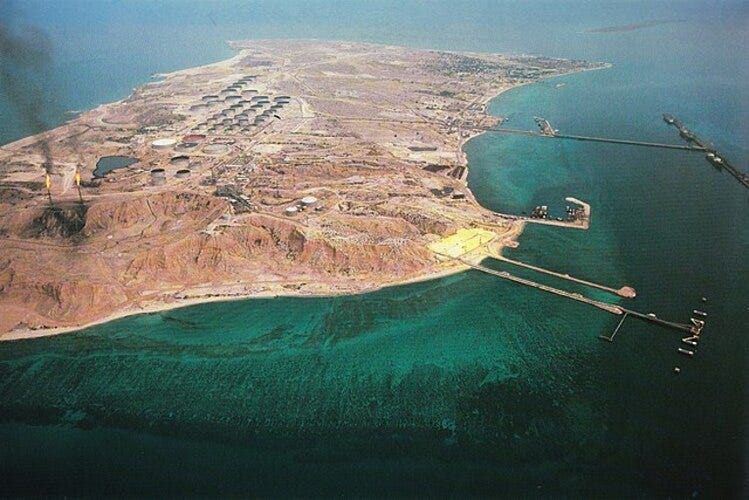
Kharg Island, located in the Persian Gulf, some 16 miles off the coast of the Bushehr province of Iran. Kharg is some 5 miles by 3 miles in size. Its oil loading facilities are visible in the above photograph.
Let us imagine that a US force sufficiently large to take the island could get to Kharg and be supplied without being blasted to pieces. Let us further assume that Iran does not have defences sufficient to take an intolerably high toll on attackers. These are two questionable assumptions, but let us make them.
First, as aforementioned, Iran has escalation dominance by virtue of the balance of resolve being in its favour. “We don’t have the ability to export oil? How about we decimate Gulf oil infrastructure so nobody does?” Then, the world would face the inevitable arrival of the economic catastrophe described in detail in last week’s Brief: global depression, worldwide civil unrest, and the re-wiring of postwar civilisation.
Secondly, the example of Snake Island, off the southern coast of Ukraine, is instructive. Russia and Ukraine attempted to occupy the Island in 2022, and both sides were decimated by air attacks when they did. Concentrating troops in static locations on a small island close to the Iranian coast would be a mass-casualty event waiting to happen.
Option 4: A limited ground invasion of Iran, concentrated on the coastal areas. The public strategic thinkers have incorrectly fixated on the closure Strait of Hormuz as the strategic pivot of this war. The argument goes that if it could be pried open, then Iran could be pounded at leisure. Even if that did not lead to Washington’s purportedly desired outcome of regime change, it would at least smash the country to bits. So, if the USAF cannot suppress Iranian fires sufficiently to keep the Strait open, and the US Navy cannot protect ships as they pass through, then a land invasion is the only remaining option.
The US has forces for such an invasion (which makes it a more tempting option). Its large special forces corps (SEALs, Green Berets, Delta, et al) can secure drop zones and beach heads, and disrupt enemy defences deep into the battlespace. They would be followed near simultaneously by elite units like the US Army Rangers, 82nd Airborne, 101st Airborne, and the US Marine Corps, who would open key logistics corridors for the heavy boys to move through. A zone as deep as, say, Shiraz and Zahedan might be taken.
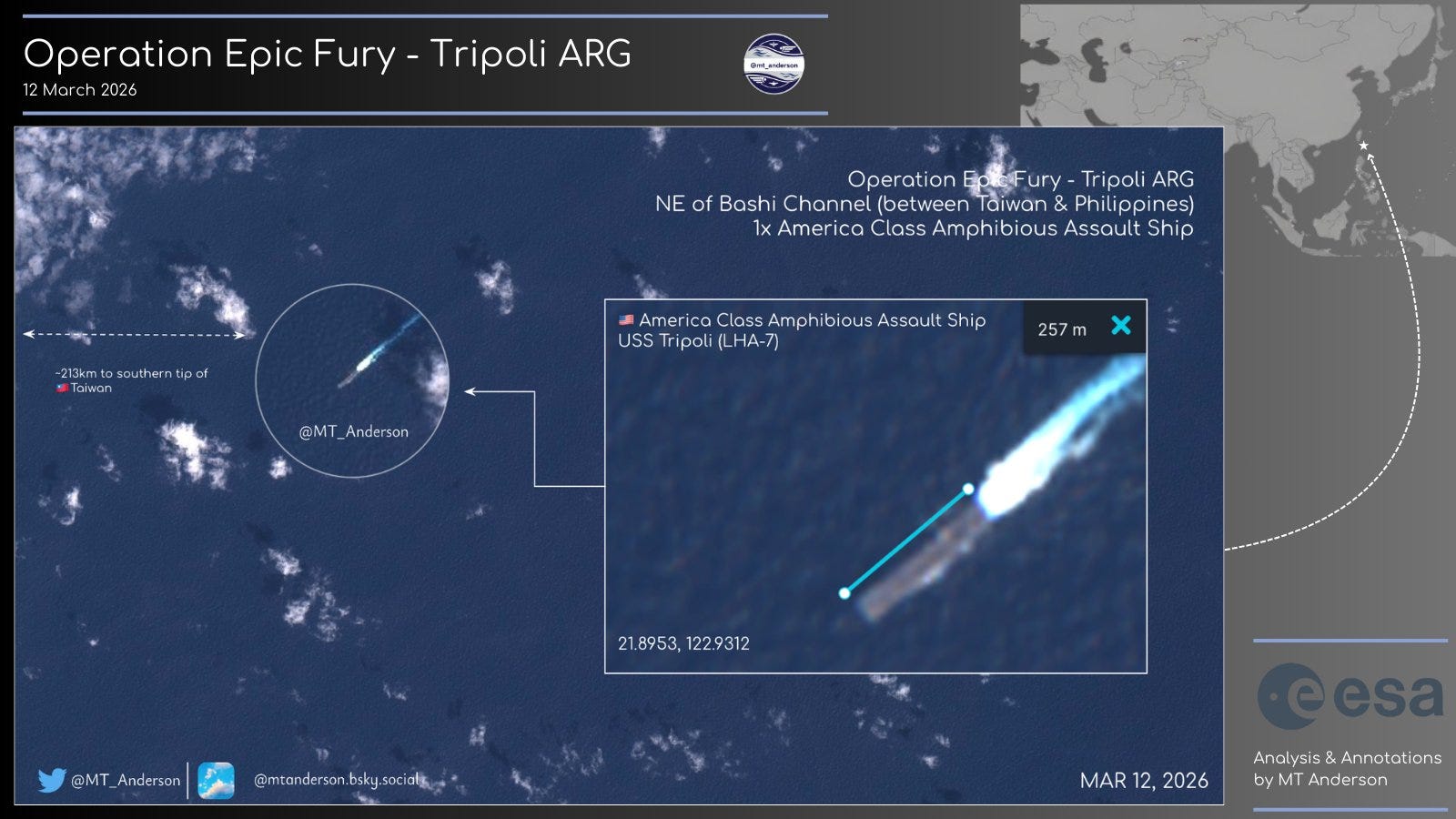
Satellite analysis showing USS Tripoli, an America Class amphibious assault ship (and aircraft carrier) steaming through the South China Sea, likely on her way to the Middle East. Note the long tail suggests high speed. The Tripoli is the flagship of US 31st Marine Expeditionary Unit, which comprises of some 2,000-2,500 US Marines, artillery, logistics and command elements. The Tripli herself carries as many as 20 F35B stealth fighters, M22 Osprey tiltrotor craft, Viper attack helicopters, amphibious assault boats, light armoured vehicles and LCAC assault hovercraft. USS Tripoli and her support elements have more recently been observed passing Singapore.
Let us ignore for a second whether this is militarily feasible or politically tolerable (Multipolarity believes that US domestic politics on its own would be frighteningly explosive). Would a limited ground invasion actually solve the strategic problem the US faces? No! The fault comes from the assumption that the closure of the Strait of Hormuz is the salient problem. It is not! In fact, the central strategic problem of the conflict is the reduction in the flow of oil from the Gulf into the global economy caused by the USAF’s inability to suppress Iranian ground fires. At present, Iran is achieving this reduction by closing the Strait. But in the event it is reopened, it could simply move to attacking infrastructure in the Gulf to achieve the same.
This is an important matter. Amerikanets, the military analyst and polemicist, has pointed out that on this matter we should be grateful that Iran has the opportunity to shut the Strait, because it means that it does not have to do permanent catastrophic damage to Gulf oil infrastructure (and thus the global economy) in order to pursue its strategic aims in an existential war. A US ground invasion that prised the Strait open, or looked as though it was about to prise it open, would remove this option.
We have thereby shown that each of the main four options for escalation available to President Trump are questionable prospects at best. Even if they tactically succeeded, they would make the strategic outlook worse for the United States. Yet the current situation in the war suggests that the Trump Administration will still attempt to escalate. Why? Because, it looks unlikely that the USAF will be able to suppress Iranian fires before the economic pain becomes intolerable and the US is forced to seek terms.
Therefore, Trump must do something. He has three options. One, leave without a deal (thus committing personal political suicide and consigning the US to a major strategic defeat that will have severe consequences for its allies and its own strategic position). Two, seek a deal, which, as aforementioned, is at present unlikely to yield anything much better than the outcome of option one. Three: escalate, likely in one of the ways detailed above.
Multipolarity would be delighted to hear in the comments whether any readers and summon the spirit of Alexander, and slice through this Gordian Knot.
The Final Escalation

The ultimate and final escalation is, of course, the use of nuclear weapons. It is certainly worth asking whether they might be used in a scenario in which the US and especially Israel face a strategic defeat against Iran. What if Israel simply cannot stop Iran’s missile attacks on Tel Aviv at a cost politically acceptable for Benjamin Netanyahu? Multipolarity cannot be the only one to have fleetingly considered this prospect.
Nuclear weapons are highly unlikely to be used, however. On 15 March, Anusar Farooqui, the academic and hedge fund principal, wrote a pithy history of the academic work on this question. The story starts in 1954, during the First Indochina War. Mr Farooqui writes that US Secretary of State John Foster Dulles had “made some of the most unambiguous threats of nuclear use to deter North Vietnam (and the communist great powers behind it) from destroying the last remaining French position in Indochina at Điện Biên Phủ. The communist called his bluff and destroyed the French” position.
This humiliation of the US, Mr Farooqui argues, instantly triggered a major military-intellectual revolution. He contends that “the first and most important critique of Dulles’s failed policy was by WW Kaufmann, the author of US nuclear strategy from 1961 to 1980. Kaufmann argued in effect that nuclear threats cannot be credibly made on sub-strategic questions.”
There would be a huge cost to Israel if it used nuclear weapons in Iran — and one not confined to an even more intense version of the international diplomatic condemnation it frequently elicits. In fact, such use would almost certainly set off a chain of proliferation in the Middle East. If Israel can attack Iran, and then nuke it when things go badly, then surely Turkey, Saudi Arabia, Iran and Egypt would decide they must have nuclear weapons, no matter the cost. Would that be in Israel’s interests? Surely not. Furthermore, the cause of non-proliferation would be ended by such a flagrant break of the nuclear taboo. It is likely a great many states would go nuclear, many of which would be obviously against the interests of Washington.
In this context, therefore, Israeli or American nuclear posturing would not be credible, and the bluff would be called just as was John Foster Dulles’s.
Until the Clouds Roll in a Little…
Did you think the effort we put into this brought you some value? Then take 10 seconds to subscribe, for free, right now. Take another ten to share this with somebody who would benefit from reading it. Oh, and if you like a killer deal, for only eight bucks you can subscribe to Multipolarity the Podcast on Patreon. In return, you’d get all our premium podcast episodes, including the back catalogue (in which there are some absolute gems). Knockout deal!
Multipolarity Brief will return next Tuesday. Until then, farewell and good luck.
This hasn't been hard to predict - we're beyond the point of no return, and the escalation is on autopilot. Chances for a deal are way beyond dead.
The method attempted by the US vs Iran will ofc will be more bombing. Maybe with some drone-age innovations, like trying to destroy all moving vehicles, or smth. Don't know what Marines are for, but unlikely to result in anything other than a decision to bomb more and some PR (oh they so heroically tried to sneak in unexpectedly via Afghanistan / tried to defend a Iraqi US base from an angry mob). Wouldn't want to be those guys that's for sure.
Thanks
I'm enjoying these, they are adding context to your podcasts