
Multipolarity Brief: Issue 21 — Iran Special X
Trump pulls out, but who finished first?; Missile accomplished; Multipolarity Brief victory lap.

Trump pulls out, but who finished first?
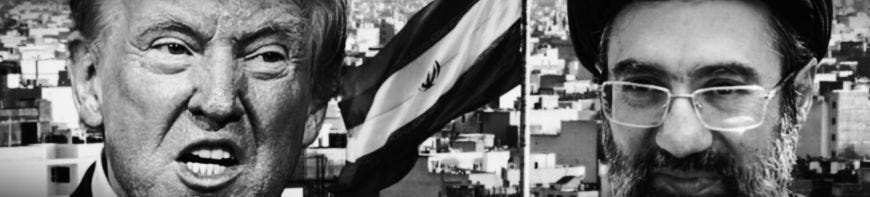
So who won? Let’s move beyond the hot takes, opinion columns and general wailing. What we need is an objective framework through which to make sense of the ceasefire. Any such effort must begin with an accounting of the aggressor state’s war aims. Did they achieve what they started the war to achieve in the first place? Donald Trump, of course, is famously flexible in his policy aims: his words are infamously open to interpretation. So, is it even possible to understand what US war aims were at the end of February? Yes. Yes it is. Get rid of the spin. Ignore the competing narratives. Stick only to the facts, and read carefully. Then its possible. In fact, when you do things this way, everything is clear as crystal.
Let’s walk through this step by step.
On the eve of war, during negotiations in Geneva on 26 February, the US team presented Iran with a list of demands. In broad terms, these were:
The end of Iran’s nuclear programme, including (i) a handover, under strict US and International Atomic Energy Agency supervision, of its enriched uranium stockpile, and (ii) the physical dismantling of nuclear sites, such as Fordow, Natanz and Isfahan.
Iran must agree to never enrich fissile material again (even for medical purposes).
A limit to Iran’s missile programme, in terms of overall size and the range of individual missiles (thus removing Iran’s primary means of national self-defence).
Iran must end its support/funding/arming of regional proxies (Hezbollah, Hamas, Ansar Allah (aka ‘the Houthis’), the Shia militias in Iraq, et al).
The deal would be permanent, with no sunset clauses (unlike the 2015 JCPOA).
In exchange for compliance on all these matters, Iran would receive only minimal/conditioned sanctions relief.
On 28 February, in a national television address to announce that war against Iran had started, President Trump confirmed that these were indeed the nation’s aims. Here are the key quotes pertaining to war aims from his address.
“We will ensure that Iran does not obtain a nuclear weapon… They will never have a nuclear weapon.”; “We’re going to destroy their missiles and raze their missile industry to the ground. It will be totally, again, obliterated”; “We’re going to ensure that the region’s terrorist proxies can no longer destabilise the region or the world and attack our forces.”
President Trump went on to call for the Iranian people to foment regime change (“Finally, to the great, proud people of Iran… take over your government. It will be yours to take. This will be probably your only chance for generations.”)
Thus, we can say that the US’s war aims – no matter what is claimed now – were, at the outset of the war, as follows:
The destruction of Iran’s existing nuclear programme and the destruction or acquisition of Iran’s fissile material.
A guarantee that Iran would never pursue a nuclear programme again.
That Iran would cut off Hezbollah, Hamas, the Houthis, the Shia militias in Iraq, et al.
That Iran’s missile arsenal would be strictly limited in scale, payloads and range.
Regime change as the only way to achieve such an unconditional surrender.
The United States has failed to achieve a single one of these war aims. Let’s take one at a time.
First, far from destroying Iran’s nuclear programme, the effort to contain and curtail Iran’s efforts to proliferate is in a worse state now than it was before the war. Highly enriched uranium (the most difficult-to-obtain part of any nuclear weapons programme) is now buried deep underground in heavily fortified positions. The International Atomic Energy Agency reports that it has entirely lost access to Iran’s nuclear sites, leaving it — and us — in the dark. Damage to Iran’s nuclear facilities might have knocked the country back anywhere from six months to two years; however, the best intelligence suggests it retains something approaching breakout capacity. Meanwhile, the components of its weapons programme have not been so far out of reach for more than a decade.
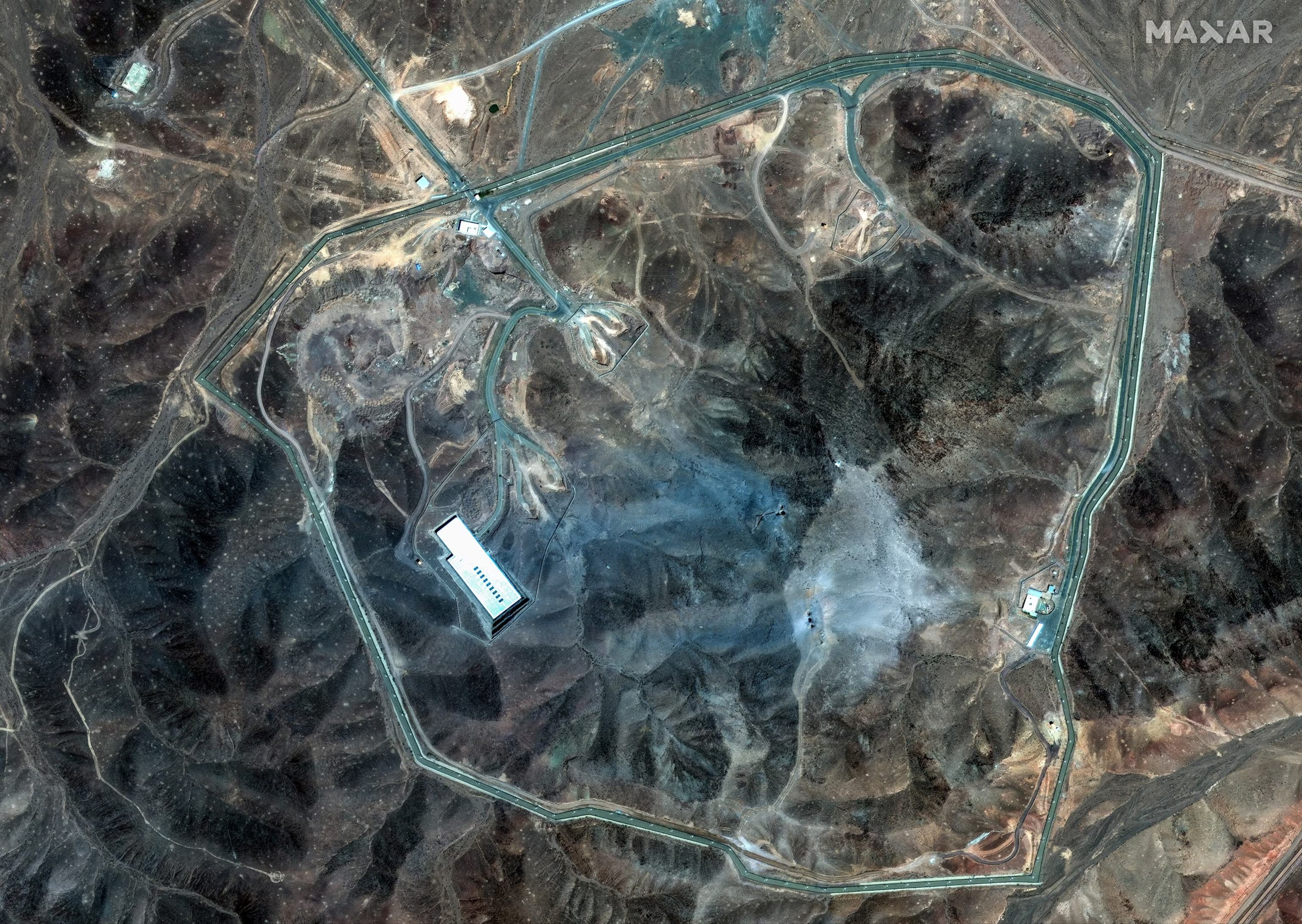
Source: ABC. A Satellite image taken after 2025’s Midnight Hammer shows holes in the mountain top created by precision US deep penetration bombs. The tunnel entrances, also visible on the image, were attacked during Epic Fury. Yet many are now being bulldozed back open, US intelligence reports.
Second, far from cutting off its proxies, Iran is for the first time defending them by attacking Israel directly. For decades, Iran’s network of proxy forces in the Middle East had acted as the main way by which it projected military power across the region. They also, however, acted as a kind of forward deterrent: an attack on Iranian interests could lead to responses by Iraqi militias, Hezbollah, the Houthis or some other group. In Israel’s case, an attack on Iran would mean fighting Hezbollah right on Israel’s northern border in addition to Iran. Think about the arrangement between the Scots and the French to deter English attacks in the Middle Ages, and you’ll get something like the idea.
Yet for the first time last week, Iran took military action to defend Hezbollah, rather than the other way around. It was a stunning display of newfound confidence. But it was also something else. American war aims demanded that Iran stop supporting Hezbollah and its other proxies. Yet there was Iran, supporting them in ways it never dared to before. Even more than with Iran’s nuclear programme, the war has left the US not only well short of its war aims, but worse off than when it started.
Third, on 12 May the New York Times reported that the US bombing campaign had not done nearly the damage to Iran’s missile capacity as the presidential administration, led by the claims of Trump himself, had implied. In fact, the Times reported that “classified assessments” showed that Iran retained some 70% of its pre-war missile stockpile and 70% of its mobile launchers. Further, it had regained 30 of the 33 missile sites it maintained along the Strait of Hormuz and was able to operate from 90% of its underground missile and drone facilities. Meanwhile, while it was true that the US had had more success against drone and missile factories, by 21 May CNN was reporting that official US intelligence assessments found Iran was rebuilding its military-industrial capacity far more rapidly than had been expected.
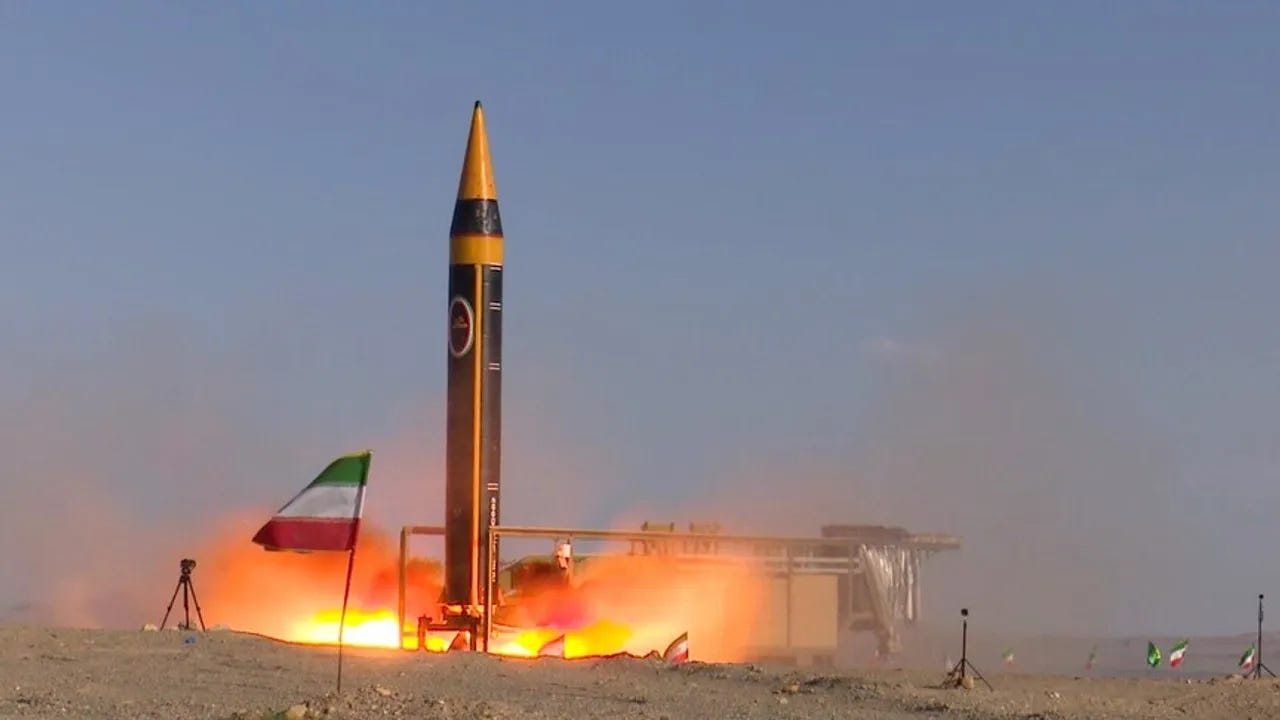
And Iranian missile firing off what appears to be a mobile launcher.
This was not just a failure to achieve one of the United States’s strategic goals: it was crucial to the outcome of the war. Without suppressing Iran’s capacity to fire missiles and drones, the US had no chance of opening the Strait of Hormuz. Thus, Iran was able to sanction Planet Earth by cutting off the flow of hydrocarbons and other commodities from the Gulf region. This, in turn, inflicted sufficient economic pain (or at least enough of a risk of massive economic pain) to force the US to negotiate.
Finally, it hardly needs to be said that the US has failed to compel regime change. It killed many members of the Iranian political and military elite — and even senior members of its clergy. Yet the regime, the system of government, remains in place. Furthermore, the hierarchy within that system retains its grip on military command and control. And, as aforementioned, it is pulling that lever with increasing confidence and assertiveness. The political goal of regime change, then, is the fourth area in which the US has failed spectacularly.
There is no way to dress this up, or spin it, or hide the truth: the US failed to secure a single one of its war aims. No reading of the plain facts could suggest anything else. Lots of big bangs, smashed buildings and killed people; not a single war aim achieved.
Missile accomplished
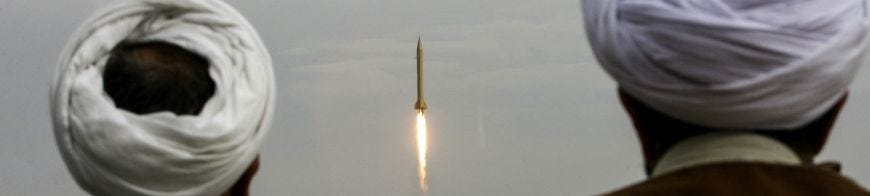
Yet America’s failure to win the war is not the same as an Iranian victory. To say that Iran won, we must prove more than just that the US failed to win. It is impossible to assess whether Iran has met its war aims because, as the defensive party, it did not state any at the onset of hostilities. In this sense, the mainstream media consensus that Iran, to an extent, “wins by surviving” is correct. The truth, however, is far more extensive and decisive than that.
As far back as the beginning of April, this Brief was explaining to readers what Iran would want in order to end hostilities. This, we argued, would involve:
A de facto, although perhaps not necessarily de jure, understanding that now Iran’s ability to control the Strait of Hormuz had been revealed, it was a fact of life hereafter. This wasv a weapon that, in many ways, is more useful than nukes: the economic consequences might be as high as a nuclear attack, and yet there are far fewer taboos about deploying it, and little prospect of nuclear retaliation. There was no way Iran would give up this voluntarily now it had been attained.
The ability to stabilise its shattered economy in the short term, and to get on the path to economic growth in the long term. Tehran knows that once the rally-around-the-flag effect is over, it will have to show economic improvement, after years of sanctions that had crippled growth and squeezed living standards. This would require immediate injections of capital and, over time, a reintegration into the global economy. Therefore, we reasoned, Iran was likely to demand some of its frozen billions of dollars back and a removal of sanctions in the long term.
Some sort of guarantee that the US and Israel would not come back for a second bite of the cherry later. This would require a non-aggression guarantee and probably some sort of concrete steps that physically make it more difficult for the US and Israel to attack in future. We suggested guarantees from Gulf states that they would no longer allow US or IAF overflights; however, other means are available.
More recently, a fourth point has emerged: it has become increasingly clear that Iran wants any peace agreement to cover Israel’s attacks on Lebanon and Hezbollah.
How does the prospective Memorandum of Understanding (known as the Islamabad Memorandum) compare with Iran’s aims? The first thing to understand is that the MOU is not, in theory, the final deal. It is just an agreement to start negotiating toward a final agreement. However, it does give us a chance to assess how Iran has done in achieving its war aims.
+++++As we were about to go to press, US officials at the G7 meeting released the full text of the MOU for the first time. It is important to read the Memorandum in full, so as to avoid the confusion created by media spin.+++++
The United States of America and the Islamic Republic of Iran have jointly agreed in good faith on [ __ date] on the following:
1 — The United States of America and the Islamic Republic of Iran and their allies in the current war are signing this MOU to declare the immediate and permanent termination of military operations on all fronts, including in Lebanon, and undertake from now on not to initiate any war or any military operation against each other, and to refrain from the threat or use of force against each other, and ensuring the territorial integrity and sovereignty of Lebanon. The final deal will confirm the permanent termination of the war on all fronts, including in Lebanon and other provisions of this paragraph.
2 — The United States of America and the Islamic Republic of Iran undertake to respect each other’s sovereignty and territorial integrity and to refrain from interfering in each other’s internal affairs.
3 — The United States of America and the Islamic Republic of Iran commit to negotiating and achieving the final deal in maximum 60 days, extendable with mutual consent.
4 — Immediately upon the signing of this MOU, the United States of America will begin the removal of its naval blockade and any disturbances or impediments against the Islamic Republic of Iran, and will fully end the naval blockade within 30 days. During this period, the traffic of vessels will be in proportion to the numbers of pre-war traffic being restored by the Islamic Republic of Iran. The United States of America further undertakes to remove its forces from the proximity of the Islamic Republic of Iran within 30 days after the final deal.
5 — Upon the signing of this MOU, the Islamic Republic of Iran will make arrangements using its best efforts for the safe passage of commercial vessels with no charge, for 60 days only, from the Persian Gulf to the Sea of Oman and vice versa. The traffic of commercial vessels will immediately start, and considering the need for removing the technical and military obstacles, and demining by the Islamic Republic of Iran will be instated within 30 days. The Islamic Republic of Iran will conduct dialog with the Sultanate of Oman to define the future administration and maritime services in the Strait of Hormuz in discussion with other Persian Gulf littoral states in line with the applicable international law and the sovereign rights of coastal states of the Strait of Hormuz.
6 — The United States of America undertakes with regional partners to develop a definitive, mutually agreed plan with at least USD 300 billion for the reconstruction and economic development of the Islamic Republic of Iran. The mechanism for the implementation of this plan will be finalized as part of a final deal within 60 days. All required licenses, waivers and permissions needed for the relevant financial transactions will be granted by the United States of America.
7 — The United States of America undertakes to terminate all types of sanctions against the Islamic Republic of Iran, including the United Nations Security Council resolutions, IAEA Board of Governors resolutions, and all unilateral US sanctions, primary and secondary, in an agreed upon schedule as part of the final deal. The Islamic Republic of Iran and the United States of America acknowledge the critical importance of the sanctions termination issue above mentioned, and expressed their intentions to immediately address these issues in the negotiations in order to achieve mutual agreement on them.
8 — The Islamic Republic of Iran reaffirms that it shall not procure or develop nuclear weapons. The United States of America and the Islamic Republic of Iran have agreed to resolve the disposition of stockpiled enriched material pursuant to a mechanism that will be mutually agreed upon in accordance with the schedule mentioned in paragraph seven, with the minimum methodology to be down blended on site under the supervision of the IAEA. The two parties also agreed to discuss the issue of enrichment and other mutually agreed matters related to the Islamic Republic of Iran’s nuclear needs, based on a satisfactory framework being agreed upon in the final deal. The final deal will confirm the provisions of this paragraph. The United States of America and the Islamic Republic of Iran acknowledge the critical importance of the nuclear issues above mentioned. They express their intention to immediately address these issues in the negotiations in order to achieve mutual agreement on them.
9 — Pending the final deal, the United States of America and the Islamic Republic of Iran agree to maintain the status quo. The Islamic Republic of Iran will maintain the current status quo of its nuclear program, and the United States of America will not impose any new sanctions and will not deploy additional forces in the region.
10 — The United States of America undertakes that immediately upon the signing of this MOU and until the termination of sanctions, US Department of Treasury will issue waivers for the export of Iranian crude oil, petroleum products and derivatives, and all associated services, including banking transactions, insurances, transportation, etc.
11 — The United States of America undertakes to make fully available for use the frozen or restricted funds and assets of the Islamic Republic of Iran upon the implementation of this MOU. The United States of America and the Islamic Republic of Iran will mutually agree on the procedures related to the release of these funds during negotiations. Such funds, whether retained in the original account or transferred, shall be made fully usable for payment to any ultimate beneficiary designated by the Central Bank of the Islamic Republic of Iran. The United States of America undertakes to issue all necessary licenses and authorizations accordingly.
12 — The United States of America and the Islamic Republic of Iran agree that an executive mechanism will be established to monitor the successful implementation of this MOU and the future compliance of the final deal.
13 — After signing this MOU, and subject to the beginning of the implementation of paragraphs 1, 4, 5, 10 and 11 of this MOU, and the continuing implementation of these measures, the United States of America and the Islamic Republic of Iran will start negotiations regarding the final deal exclusively on the other paragraphs.
14 — The final deal will be endorsed by a binding UNSC resolution.
Iran gets pretty much everything it wanted.
Article 1 includes Israel and Lebanon in the ceasefire.
Article 2 gives a verbal guarantee of non-aggression (Iran can achieve much of the rest through a combination of the Hormuz weapon and pressure on the Gulf Monarchies).
Article 5 concedes that Iran can charge tolls on passage through the Strait of Hormuz, specifying that no charge will be applied “for 60 days only”. Furthermore, it specifically mentions negotiations with Oman, which Iran has said since the beginning would have a place on the board of the “Persian Gulf Strait Authority”, the body which Iran unilaterally set up to manage the Strait.
Article 6 provides for a massive $300-billion Reconstruction and Development Fund (just don’t call it reparations!) This, per Reuters, is not to be funded by the US government, but by private interests from the US and from the Gulf states (one assumes investment funds close to the US administration and Gulf monarchies — you all know the usual suspects).
Article 7 provides for the end of all sanctions if Iran strikes a deal on its nuclear material.
Article 8 makes it plain that the nuclear deal will be no worse than the JCPOA, specifically mentioning “minimum methodology”.
Article 10 gives Iran oil sanctions relief just for signing the MOU.
Article 11 provides for the return of the tens of billions of frozen Iranian funds.
On 6 March, not a week into the war, Donald Trump wrote in a Truth Social post that “There will be no deal with Iran except UNCONDITIONAL SURRENDER!”
How right he was.
Alas, given the course of the war, this is about the best Washington might have hoped for. The US was defeated on the battlefield: it had failed to suppress Iran’s missiles and drones, and thus was bringing the world closer to economic catastrophe every minute the war continued. There were no good options for escalation. Unilaterally upping and leaving would have been even worse than this deal in terms of what it would have left in the Middle East.
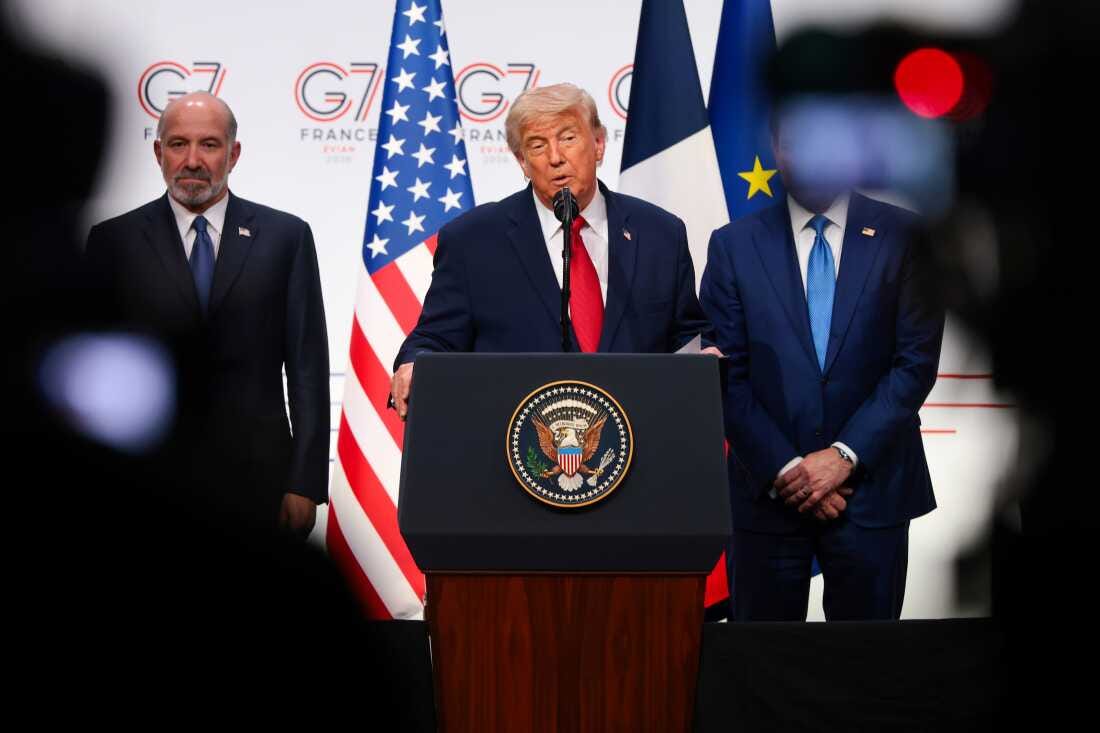
Trump at the G7 meeting in France today, trying to spin the un-spinnable: an unambiguous US defeat in war.
But, then, as Multipolarity Brief readers, you knew this would happen. As early as the beginning of April, the Brief was explaining that something very much like this MOU was the only sort of deal likely. We literally laid it out it in plain English on 8 April — way earlier than the mainstream press, which even now is shocked, and earlier than even most of the specialised press grasped what was happening. We explained as early as 18 March that there were no good options for escalation. We went into even greater detail on this matter on 23 April, running the numbers to show that a land invasion was beyond US capacity. As far back as 10 March, we showed that the US was losing the air war, and was likely to continue losing. And fully two months ago, on 16 April, we told you why the US blockade would not force Iran to make significant concessions.
If you had just read the Multipolarity Brief and nothing else from the beginning of the war, you would have been more informed than most of the so-called experts interviewed in the news and the papers, let alone the average person.
A little pat on the back is deserved for this one, we think.
Until the clouds roll in a little
Guys, seriously, I think we’ve done a good job covering the Iran War. We’ve been almost completely right, and for the right reasons. That’s because we, unlike the mainstream media — who are really the ones who should be doing this — make great efforts to do proper research and analysis. Could we therefore ask you to make a small effort to subscribe for free right now. This helps us a lot, and even though it only takes you ten seconds, we very much appreciate it.
But realistically, after so many of our calls have been proved right, perhaps it’s time to get a paid sub to support our efforts. It only costs the equivalent of a couple of pints in a pub. And, as a bonus, paying subscribers get access to the secret club that are our premium podcast episodes, AND the entire back catalogue of premium podcasts. That’s worth eight bucks a month by itself. A belter of a deal, everybody agrees.
If you really can’t spare the price of two pints for a whole month’s content, then could do us a favour? Share this with somebody who would benefit from reading it. Or announce on social media how much you enjoyed it. Thank you in advance.
The Multipolarity Brief will return next week, but between now and then, more content will appear hear. Until then, farewell and good luck.
This "Iran Special" is fine detail as to what happened and is happening.
Since we are on the subject of Iranian Uranium here are a couple of articles indicating that, even with large parts of its nuclear infrastructure destroyed, Iran (having irreversibly acquired vast amounts of technical, engineering and manufacturing knowledge) will only take weeks to manufacture a nuclear device:
Iran’s Nuclear Weapon Program is Still a Threat - https://nebula.wsimg.com/2d7466f68214e953f932ba28294292ef?AccessKeyId=40C80D0B51471CD86975&disposition=0&alloworigin=1
"Before the attacks, Iran had a stockpile of about 440 kilograms of 60% enriched uranium. This material can easily be further enriched to produce 90% enriched uranium. Assuming 20 kilograms of 90% enriched uranium per weapon, this Iranian stockpile could produce between 8 and 12 nuclear weapons"
"Before the bombing began, Iran had 82 cascades of advanced centrifuges. Yet it would take only two cascades to efficiently convert the 60% enriched uranium to 90% enriched uranium sufficient for 12 nuclear weapons. It would take about two and one half weeks in order to produce sufficient 90% enriched uranium for a nuclear weapon."
Iran’s Conversion of Uranium Hexafluoride to Uranium Metal Not a Bottleneck to an Iranian Nuclear Weapon - https://nebula.wsimg.com/5cb30d7e699d6da2b9f43d95c7bea48c?AccessKeyId=40C80D0B51471CD86975&disposition=0&alloworigin=1
"However, the conversion process from hexafluoride to metal is fairly simple. Due to criticality concerns, Iran could only process small batches of around four kilograms of 90% enriched uranium at a time. Therefore, the conversion facility would use only laboratory scale equipment"
"The preparation for the production of uranium metal could be performed in parallel with the Iranian efforts to restore its ability to produce the 90% enriched uranium. Iran could test the new facility by practicing using natural uranium. This way, there would be no delay when the highly enriched uranium actually became available."